

How Children’s Wisconsin Is Leading the Fight Against Gun Violence
The 5-year-old girl playing at a friend’s house who found the family’s handgun and inadvertently shot herself.
The 9-year-old boy who was accidentally shot by his older brother who had taken their dad’s hunting rifle to practice in the backyard.
The 16-year-old girl struck by a stray bullet while riding her bike home from school.
The 12-year-old boy experiencing a mental health crisis who took his dad’s gun from the hallway closet and attempted to take his own life.
Tragedies like these and so many others come to the Children’s Wisconsin Emergency Department every week. In 2025, Children’s Wisconsin cared for 100 children with gunshot injuries, seven of whom didn’t survive. And through June of 2026, they’ve cared for 46.
Providers at Children’s Wisconsin are experts at treating firearm related injuries in kids. And the Community Health experts from Project Ujima provide mental health and social support to those impacted by gun violence.
But what if we could prevent the gun injury from ever happening in the first place?
That’s what a team of providers, caregivers and social workers at Children’s Wisconsin are trying to accomplish.
Tackling the Problem
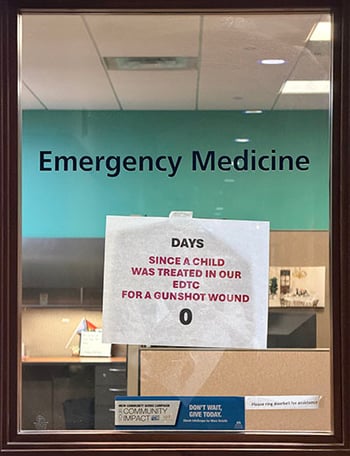 To address the gun violence epidemic facing our children, there must be a comprehensive, whole child, whole health system approach.
Safe at Home is part of the Children’s Wisconsin Safety Center. They’ve been helping families keep their children safe since 2010. At first, the program focused on home-proofing products, distributing items like baby gates, cabinet latches, doorknob covers and furniture straps.
But in 2020, something changed. Gun injuries among children skyrocketed. In fact, they surpassed motor vehicle accidents as the leading cause of death in children. In response to this, Safe at Home started to focus more intently on gun injury prevention.
“We drive our prevention work based off data trends,” said Latoya Stamper, APSW, CPST, Manager of the Children’s Wisconsin Safety Center. “We started seeing more and more gun related injuries. And, at the same time, we also started seeing more kids test positive on the suicide screening that is given to everyone in our Emergency Department. We wanted to make sure these kids and their families were safe at home.”
In 2022, with financial assistance from the Children’s Wisconsin Foundation, Safe at Home started to distribute safe gun storage products to families who were at risk and did not have a safe storage product available to them. With limited supplies, this program was limited to the Children’s Wisconsin Emergency Department and a few primary care offices.
Open and Honest Dialogue
Around this same time, Jennifer Zaspel, MD, DFAACAP, Medical Director of Emergency Mental and Behavioral Health at Children’s Wisconsin, was working with kids in mental and behavioral health crises.
“A big part of that crisis work was suicide prevention,” said Dr. Zaspel.
In 2024, Dr. Zaspel applied for a Comprehensive Suicide Prevention Program grant from the Wisconsin Department of Health Services (DHS). Part of that grant supported Counseling on Access to Lethal Means (CALM) education courses.
“CALM is an education tool to help caregivers talk with patients and families about how to reduce access to lethal means when someone is at risk for suicide or self-harm,” said Dr. Zaspel. “A lot of that training focuses on firearms. While medications are most frequently used in suicide attempts, firearms are most frequently used in suicide deaths.”
Sadly, firearms are a passionate political topic, and providers aren’t always comfortable or prepared to broach such a charged topic. The CALM Clinical Workshops give them the tools to have those important conversations in open, honest and nonjudgmental ways.
“This is supposed to be an open, collaborative conversation,” said Dr. Zaspel. “Our goal is to meet someone where they're at and try to move the needle closer to safety.”
Meeting Families Where They Are
The CALM Clinical Workshop can broadly be broken down into three main components: when, what and how.
- When is it appropriate to discuss access to firearms with an at-risk person.
- What are the options for safe storage?
- How can you have these conversations in a way that promotes safety and gives the person or family choice.
“When we connected with Dr. Zaspel, we were able to expand our scope and evolve our program,” said Latoya. “We were given more resources and able to offer more safe storage device options. We now have a variety of safe storage devices that can meet the unique needs of each family. And families have been very receptive to taking the resources without any guilt or shame.”
For example, if the gun is for hunting, maybe storing it out of the home would be an option. If it’s for home safety, what are secure and accessible ways to store it in the home. Children’s Wisconsin offers cable locks, trigger locks, safes with a lock and key, and lockboxes with a fingerprint scanner, all free of charge.
Since the CALM Clinical Workshops started in 2024, 293 Children’s Wisconsin staff members have completed the training. Most of those are clinical staff, but they are also members of the Welcome Desk, Clinical Navigator and Community Health teams. And while the CALM Clinical Workshops train Children’s Wisconsin staff, they also plan to host a CALM Conversations series that is open to anyone in the community.
“The more people we have in our system who are trained to have these conversations, the more touch points we have with patients,” said Dr. Zaspel, “and the better chance we have of meeting someone where they're at.”
To that end, Children’s Wisconsin has also partnered with other hospitals across the nation to invest in the Ad Council campaign called Agree to Agree, which is focused on finding common ground to reduce the impact of gun injuries on children and teens across all communities in the United States. Agree to Agree includes conversation guides, resources and tools and social media messages.
Turbocharging the Work
With the additional funds from Dr. Zaspel’s grant, Safe at Home quickly expanded and began offering safe storage devices throughout the Children’s Wisconsin system. In 2025, they distributed 323 safe storage products across 15 Wisconsin counties. In the first half of 2026, they’ve given away 232 in 17 counties.
“Partnering with Safe at Home has been huge because they already had a lot of this framework in place. They had the means, and we were able to provide the education to help our clinical staff feel comfortable having these conversations,” said Dr. Zaspel. “Together, we've been able to turbocharge it.”
Until now, families were only approached about safe storage if the child came in with a gun-related injury or suicidal thoughts or was deemed to be at-risk from the suicide screening. To expand the program even further, the next step was standardizing the screening process and utilizing it throughout the Children’s Wisconsin system.
In June 2026, a new screening process was developed that focuses on six areas of health-related social needs: food, housing, transportation, finance, health literacy and gun violence.
“Unfortunately, gun violence has been so prevalent for our patients that we as a system felt the need to prioritize and require it,” said Madeline Winn, PA-C, a Physician’s Assistant in the Children’s Wisconsin Emergency Department and Medical Lead for the new social drivers of health screening. “It’s really a focus on prevention, early intervention and trying to identify and help families who might be storing firearms unsafely before a problem happens.”
The first phase of the screening rollout occurred at the end of June in the Children’s Wisconsin Emergency Department, Midtown Clinic, Forest Home Clinic, Good Hope Clinic, River Glen Clinic, the Neonatal Intensive Care Unit and Pediatric Intensive Care Unit in the Milwaukee Hospital and the Neonatal Intensive Care Unit and pediatric unit in the Fox Valley Hospital. The ultimate goal is to have the screening at every location and patient care unit in the Children’s Wisconsin system.
Then, when a family comes to any Children’s Wisconsin location for any reason — whether it’s a broken bone or a wellness visit — the caregiver will be given a tablet when they enter the exam room. On the tablet there are 10 questions related to the six health-related social needs. The caregiver can answer yes, no or decline to respond. All answers are then entered into the patient’s electronic health record.
For the firearm safety domain, the first question is: “Are there any guns kept in or around your home or where your child spends time?” If the caregiver answers “yes,” then another question pops up that asks, “Are they stored unloaded or locked away?” It’s that simple.
If the gun is not stored safely, someone from the care team will engage the family in a conversation and education about the importance of safe storage and ask if they would be interested in safe storage options.
“It’s about meeting someone where they're at, recognizing they have agency and choice,” said Dr. Zaspel. “I might not get someone to exactly where I, as their physician, think they should be, but I want to help get them to wherever they are comfortable.”
Leading the Way in Gun Violence Prevention
This type of coordinated, standardized and multifaceted program for gun violence prevention isn’t being done anywhere else. Other systems utilize the CALM Clinical Workshops, some systems have versions of Safe at Home and some even distribute gun locks. But no one is doing all of it together at the scale that Children’s Wisconsin is.
“Children's Wisconsin is much more advanced. We've had longstanding efforts around injury prevention for years, which makes our program unique,” said Latoya. “And word is getting out. Other systems are reaching out wanting to learn more about what we’re doing and how they can bring the same efforts to their organizations.”
In any given year, Children’s Wisconsin will care for more than 280,000 patients. That’s 280,000 opportunities to screen kids and families and help reduce the risk of gun-related injuries.
Dr. Zaspel recalled one family she saw in the Emergency Department. A mom brought her 12-year-old daughter in because she had made suicidal statements. As part of the initial risk assessment, Dr. Zaspel asked about access to lethal means. The mom said they didn’t own any firearms but her dad lived with them and he had a gun.
“I said, ‘Do you think dad would want a safe storage product so he could help your daughter stay safe?’ Mom said, ‘Yeah, I hope so. Let's call him.’”
So, right there in the patient room, the mom called her dad and put him on speakerphone. Dr. Zaspel had a nice conversation, and the mom left the hospital with a free trigger lock for him to use.
“This was a mother who was understandably very, very scared and there was an instant wash of relief when we talked about how we’ll make sure her dad has everything he needs to keep his firearm safely stored,” said Dr. Zaspel. “For families in these situations, this is something they can do right away. They’re feeling very much out of control as they’re watching their child struggle. This gives them a sense of control.”
To learn more about Safe at Home, visit the Children’s Wisconsin Safety Center.
Children's Wisconsin Resources

Written by
Writer
Related Stories
No related articles found.