

Helping Sloane Shine: How a Whole Team Came Together To Tackle a Rare Vocal Cord Disease
Sloane was nestled in her dad’s arms in the Neonatal Intensive Care Unit (NICU) at Children’s Wisconsin, recovering after her C-section delivery, when she began crying. Even as a brand-new dad, Sam could tell that something was wrong.
“Right when she started crying, she turned blue,” said Sam. “She stopped breathing. I was freaking out.”
Sam frantically pushed the nurse call button, and Sloane resumed breathing as the nurse calmed her down. The next day, another nurse noticed that Sloane had stridor, or noisy breathing, when she cried.
“It sounded like she had a squeaker toy stuck in her throat,” said Sam, who initially assumed it was a complication of Sloane inhaling liquid during her delivery.
Later that same day, a specialist from the Children's Wisconsin Ear, Nose and Throat Program performed a scope procedure to examine Sloane’s airway. He found that her vocal cords weren’t moving as usual, which is why she wasn’t getting enough oxygen when she cried.
The diagnosis: bilateral vocal cord paralysis, also known as bilateral vocal fold immobility, a rare condition that affects fewer than one in 1 million infants. Further testing showed that Sloane’s vocal cord problem wasn’t caused by an underlying neurological or genetic disorder, as is sometimes the case. But even with an unknown cause, it was a serious situation. When the vocal cords can’t move, it can affect breathing, swallowing and speech. If left untreated, the symptoms can worsen and lead to life-threatening breathing difficulties.
“Pushing the Boundaries” To Achieve Better Outcomes
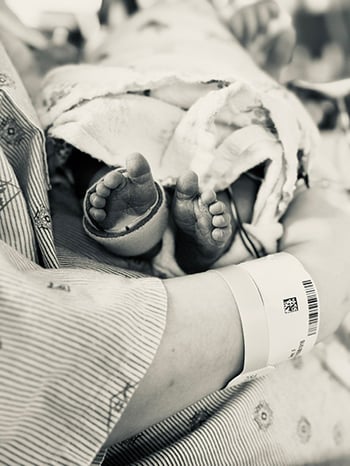 Historically, a case like Sloane’s would have required a tracheostomy — a surgery to create a hole in her windpipe for long-term mechanical breathing support — along with a feeding tube. Sloane’s parents braced for the worst after they searched online for details about the diagnosis, turning up stories of babies who required long-term medical equipment to perform the basic functions of breathing and eating.
“It was definitely scary,” said Sloane’s mom, Sarah. “It was like, ‘Oh my gosh, what is this year going to look like?’”
But Michael Gorelik, MD, a Pediatric Ear, Nose and Throat Physician at Children’s Wisconsin who specializes in airway procedures, thought there was a better way. He told Sloane’s parents about several newer surgical options to treat Sloane’s airway obstruction, and he recommended a less common procedure called a vocal cord lateralization.
“It’s not a completely novel technique,” said Dr. Gorelik, “but it’s not routine.”
It was only the second time the procedure had been done at Children’s Wisconsin — Dr. Gorelik had performed the first procedure two years earlier. Always keen to improve his minimally invasive surgery skills, he learned the technique by studying scientific literature and videos and talking with colleagues around the country.
“One of my motivations is always trying to be at the forefront of new approaches and trying things that are maybe less common, but can be successful,” said Dr. Gorelik, who is also an Assistant Professor of otolaryngology at the Medical College of Wisconsin, the academic partner of Children’s Wisconsin. This commitment to education, research and innovation allows Children’s Wisconsin doctors to constantly be pushing the boundaries of what is possible. And it’s all done in the name of improving patient care. “I believe in pushing the boundaries of what we can do to help patients and get great outcomes.”
Dr. Gorelik’s rationale for a minimally invasive approach: About half of babies with bilateral vocal cord paralysis with no known cause regain some vocal cord movement by age 1.
“If you can create enough space where they’re breathing better, that may give them time so that eventually the vocal cord function will return,” he said. “You can avoid a tracheostomy or a bigger airway reconstruction or some other surgical options that may have a bigger impact on the voice or swallowing.”
Sloane’s family was grateful for Dr. Gorelik’s willingness to try a less common approach.
“We were definitely excited that there was a different option that we hadn’t heard of, that’s obviously less traumatic than getting sent home with a trach,” said Sarah.
On Jan. 9, 2026, Dr. Gorelik created a centimeter-long incision in Sloane’s neck and then used a hollow needle to pass a surgical suture — the same medical thread used to stitch up a wound — into her airway.
“Then you use a suture to wrap around the vocal cord that’s paralyzed, and you pull it in the neck,” said Dr. Gorelik. “And what that ends up doing is it pulls the vocal cord over by the tension of the suture. You’re basically creating space to allow airflow, even if the vocal cords aren’t moving.”
Sloane’s breathing improved almost immediately.
Helping Sloane Eat Safely
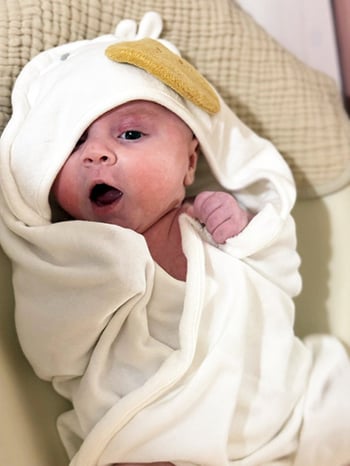 After Sloane healed from the procedure, the next challenge was ensuring that she could eat safely without inhaling liquid into her lungs — a risk now that her vocal cords were fixed in a more open position. Long-term liquid in the lungs can cause pneumonia, asthma and chronic lung changes.
“We had to figure out how to position Sloane best for the safest swallowing,” said Katherine Frontier, MS, CCC-SLP, the Pediatric Speech-Language Pathologist who worked with Sloane in the hospital. “And that took a little bit of time to tease out.”
Katherine first conducted a swallow study — using a video X-ray to watch how Sloane ate. Through a meticulous process of adjustments, Katherine discovered that Sloane needed to be positioned on her right side and fed a thickened, higher-calorie formula to swallow safely.
“With a slightly thickened liquid, she was able to protect herself as long as she had her right side down,” said Katherine. “That slightly thickened liquid allows a little bit more time. Like when you’re drinking a milkshake, you’ve got to work a little bit harder with your swallow, and it gives more time for that liquid to pass by and go down your esophagus.”
But even on her right side, Sloane continued to get liquid in her lungs. Katherine and the nursing staff gave her small portions of thickened formula in a slow-flow bottle and then switched to finishing the meal via a feeding tube when Sloane started to gurgle.
They thickened her formula even more, but that tired out Sloane.
After one especially difficult week, it seemed inevitable that Sloane would go home with a feeding tube. “Give me another week,” Katherine told Dr. Gorelik and Sloane’s parents.
Then something clicked. One day, Sloane’s parents arrived at the hospital to find Sloane taking a full bottle. Her feeding tube was gone.
Katherine whispered to Sarah with a smile: “I think you’re getting discharged tomorrow.”
And sure enough, the next day, after 42 days in the NICU, Sloane was discharged home with no medical devices.
The Importance of Interdisciplinary Care
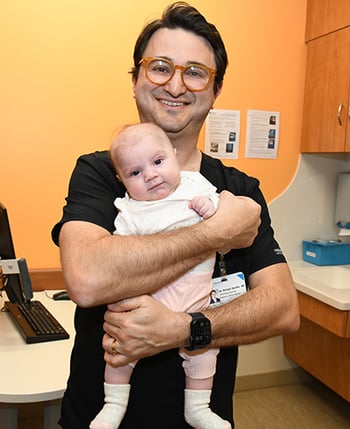 Sloane’s outcome exceeded expectations, a tribute to the combined expertise and support of the NICU, anesthesia, otolaryngology, speech pathology and dietitian teams.
“The success with a complex procedure is very much interdisciplinary,” said Dr. Gorelik. “I think that’s why a case like this is best handled at a pediatric hospital like Children’s Wisconsin.”
After weeks in the NICU, Sloane’s parents felt especially close to Sloane’s nurses.
“It’s kind of like a little family, and they help raise all these babies in the NICU,” said Sarah. “It was bittersweet to leave.”
Sloane is doing well at home. She continues to be monitored by Dr. Gorelik, who saw both of Sloane’s vocal cords move slightly during her last visit — an encouraging sign. He might leave the suture in or remove it depending on whether Sloane regains full movement as she grows. Although it’s possible that Sloane’s voice might be slightly weaker if she doesn’t regain total vocal cord movement, Dr. Gorelik isn’t expecting any major complications.
Sloane also had a follow-up appointment with the outpatient speech-language pathology team to ensure that her bottle feedings were still safe, and she will likely return when she transitions to solid food.
“She doesn’t need regular therapy because she’s so great at eating and thriving,” said Katherine. “But we just want to make sure that she can still advance and keep herself safe.”
It wasn’t at all what Sam and Sarah expected when they first researched Sloane’s condition, and that’s why they wanted to share their family’s experience.
“We feel really lucky,” said Sarah. “Sloane’s a miracle case.”
Children's Wisconsin Resources

Written by
Writer
Related Stories
No related articles found.