

How To Tell When Your Child Is Ready for a Booster Seat
Raising a child often seems like a never-ending series of transitions. Breast milk to purees to solid foods. Sitting to crawling to walking. Cradles to cribs to big-kid beds. Daycare to pre-school to kindergarten.
For many of these, you will know when your child is ready. But when to switch from a car seat to a booster seat can be less obvious. Especially since there are both Wisconsin laws and best practice recommendations to take into consideration, not to mention well-intentioned advice from neighbors, friends and families!
That said, there are two hard and fast rules:
- Always make sure your child is within the weight and height limits of their seat.
- Always follow manufacturer guidelines for whichever seat they are in: rear facing, forward facing or booster seat.
A good starting point to help you decide if your child is ready for the booster seat is the minimum required by Wisconsin law to use a booster seat. Wisconsin law states that a child must be both 4 years old and 40 pounds to use a booster seat. Once your child has met the minimum requirements, best practice recommendations can be the next step in determining when to transition into a booster seat.
A booster seat does not restrain a child like a harnessed car seat. Instead, it positions the vehicle’s seat belt so it fits properly across the strongest parts of the child's body. In a booster, the lap belt should lie low across the upper thighs, not the stomach, and the shoulder belt should cross the middle of the chest and shoulder, not the neck or face.
The Safest Recommendations to Transport Your Child
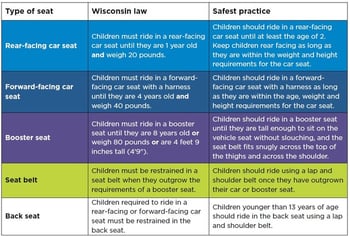 Best practice is the “gold standard of protection” and offers the safest recommendations to transport your child. The best practice recommendation is to keep children in a forward-facing harness seat for as long as possible beyond the 4 years old and 40 pounds minimum requirements.
The five-point harness provides greater protection than the three points of contact of a seat belt. There are many high-weight harness seats that can accommodate older, heavier and taller children to keep them in a harness longer.
If your child has reached 4 years old and 40 pounds and is soon to outgrow their current forward-facing harness seat, you may wonder whether to purchase a higher-weight harnessed seat or transition to a booster. Ask yourself: Is your child mature enough to sit upright for the entire trip without being held in place by a harness?
The booster seat and seat belt can only do their job in a crash if your child is sitting upright. If your child is slouching, bending over to reach toys, playing with the seat belt or frequently moving out of position, consider a harnessed seat with higher height and weight limits. While some children may be mature enough to use a booster at this stage, best practice is to keep children in a properly fitted harnessed seat until they reach the seat's maximum height or weight limits.
Understanding Laws and Best Practices
When it comes to car seat safety, the laws and guidelines can be overwhelming. Below is a helpful overview of the different stages of car seats, laws and best practice.
We cannot stress the importance of car seats enough. Simply put, when used and installed correctly, car seats and safety belts can prevent injuries and save lives. Correctly used child safety seats can reduce the risk of death by as much as 71%.
If you have any concerns about your car or booster seat installation, you can call (414) 607-5280 to schedule a free appointment at the Children’s Wisconsin Booster and Car Seat Clinic. You can also find additional car seat information and safety resources on the Children’s Wisconsin Safety Center website.
Children's Wisconsin Resources

Related Stories
No related articles found.