Stool Tests

How To Collect Stool for Testing

Stool is another name for poop. It may be helpful to have a lab look at poop to know how to take care of a person. The lab calls what is collected for the test a stool specimen or sample. You are being asked to bring a stool sample from home for a test.

Important: Print your child’s name, birthday, and date and time the stool was collected on the container or on the card.

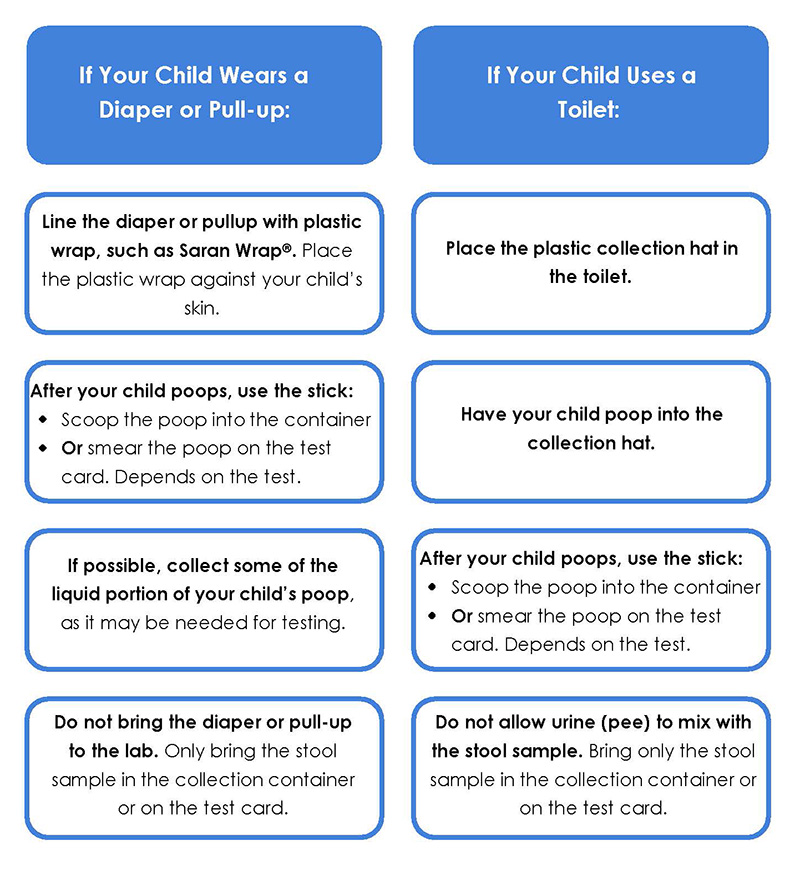
If Your Baby or Child Wears a Diaper or Pull-Up:

  1. Line the diaper or pullup with plastic wrap, like Saran Wrap®. The plastic will be next to your baby or child’s skin. When your baby or child poops it will be on the plastic.
  2. Use the stick and scoop the stool into the container or smear it on the card for the test your baby or child needs. The liquid part of the stool is needed for testing, so scoop that into the container or smear it on the card if you can.
  3. Do not bring the diaper or pull-up to the lab. Only bring the stool sample in the container or on the card.

If Your Child Uses a Toilet:

  1. Put the plastic “hat bowl” in the toilet. Your child can go to the bathroom into the hat.
  2. Use the stick and scoop the stool into the container or smear it on the card for the test your child needs. Do not include urine, or pee, in the container.

When You Are Ready To Bring the Stool Sample to the Lab:

  • Allow extra time at the lab to register.
  • Each stool sample must be put in its own container. Do not put more than 1 stool sample in the same container, unless the directions tell you to.
  • The type of tests your child needs are marked. Get only one stool sample per day for all the tests except fat tests.

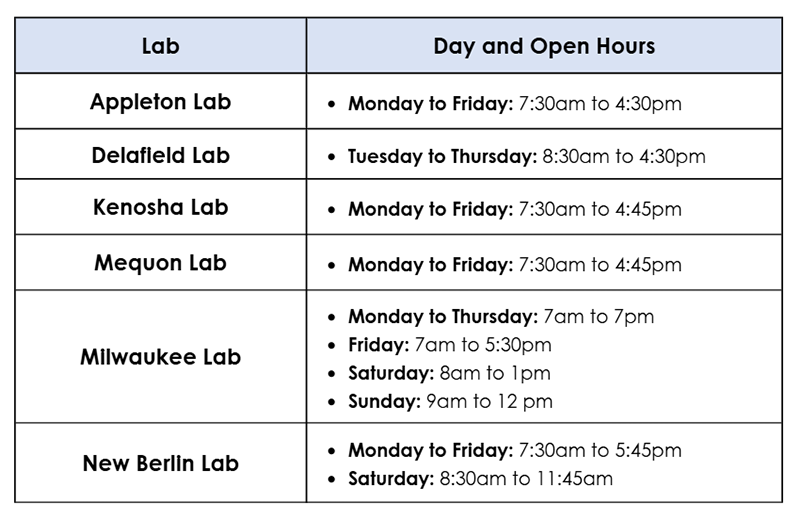
Bring the Labeled Containers to One of These Labs During These Hours:

Milwaukee Lab:
  • Monday through Thursday: 7am to 7pm
  • Friday: 7am to 5:30pm
  • Saturday: 8am to 1pm
  • Sunday: 9am to 12 pm
Kenosha Lab:
  • Monday through Friday: 7:30am to 4:45pm
Mequon Lab:
  • Monday through Friday: 7:30am to 4:45pm
New Berlin Lab:
  • Monday through Friday: 7:30am to 5:45pm
  • Saturday: 8:30am to 11:45am
Delafield Lab:
  • Wednesday: 8:30am to 4:30pm
  • Thursday: 8:30am to 4:30pm
Appleton Lab:
  • Monday through Friday: 7:30am to 4:30pm

Stool Tests:

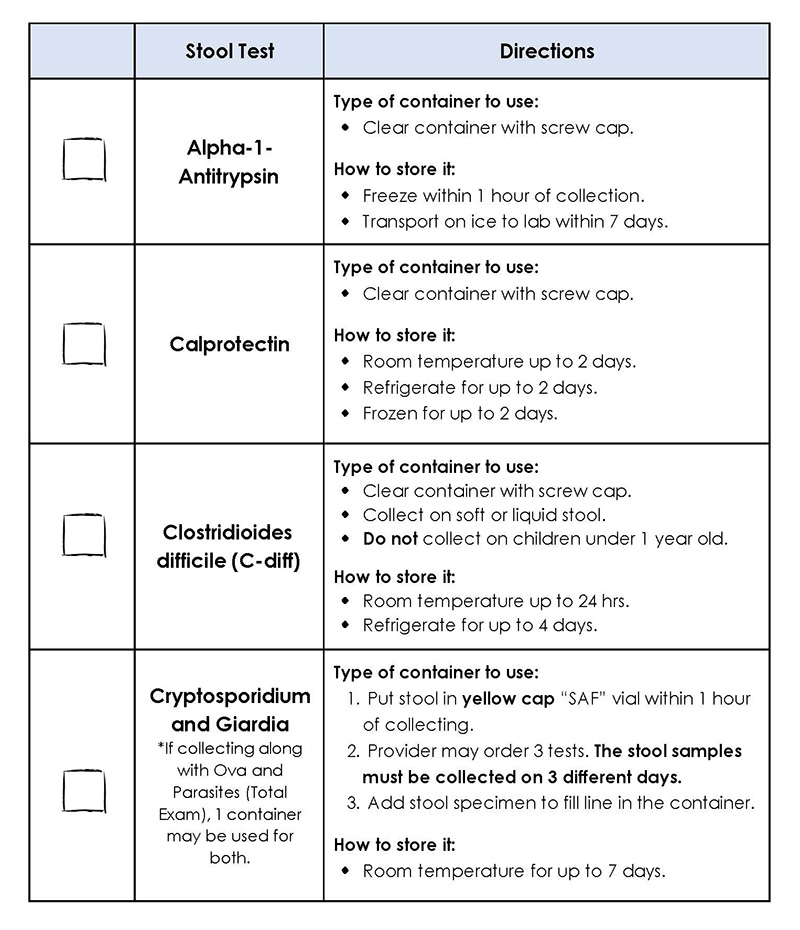
Alpha-1-Antitrypsin

Type of container to use: Clear container with screw cap.

How to store it:

  • Freeze within 1 hour of collection.
  • Transport on ice to lab within 7 days.
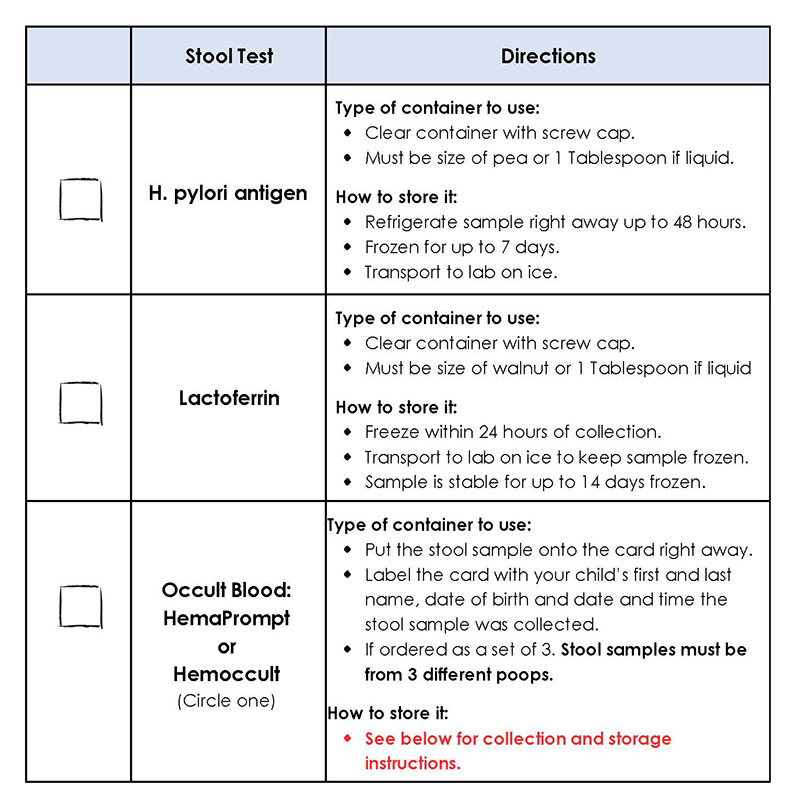
Blood Occult: HemaPrompt or Hemoccult (Circle one)

Type of container to use:

  • Put the stool sample onto the card right away.
  • Label the card with your child’s name, birthday, date and time the stool sample was collected.
  • If ordered as a set of 3. Stool samples must be from 3 different poops.

How to store it: See storage and collection info below.

Calprotectin

Type of container to use: Clear container with screw cap.

How to store it:

  • Room temperature up to 2 days.
  • Refrigerate for up to 2 days.
  • Frozen for up to 2 days.
Clostridioides difficile (C-diff)

Type of container to use:

  • Clear container with screw cap.
  • Collect on soft or liquid stool.
  • Do not collect on children under 1 year old.

How to store it:

  • Room temperature up to 24 hrs.
  • Refrigerate for up to 4 days.
Cryptosporidium and Giardia

Type of container to use:

  1. Put stool in yellow cap “SAF” vial within 1 hour of collecting.
  2. Provider may order 3 tests. The stool samples must be collected on 3 different days.
  3. Add stool specimen to fill line in the container.
    *If collecting along with Ova and Parasites (Total Exam), 1 container may be used for both.

How to store it:

  • Room temperature for up to 7 days.
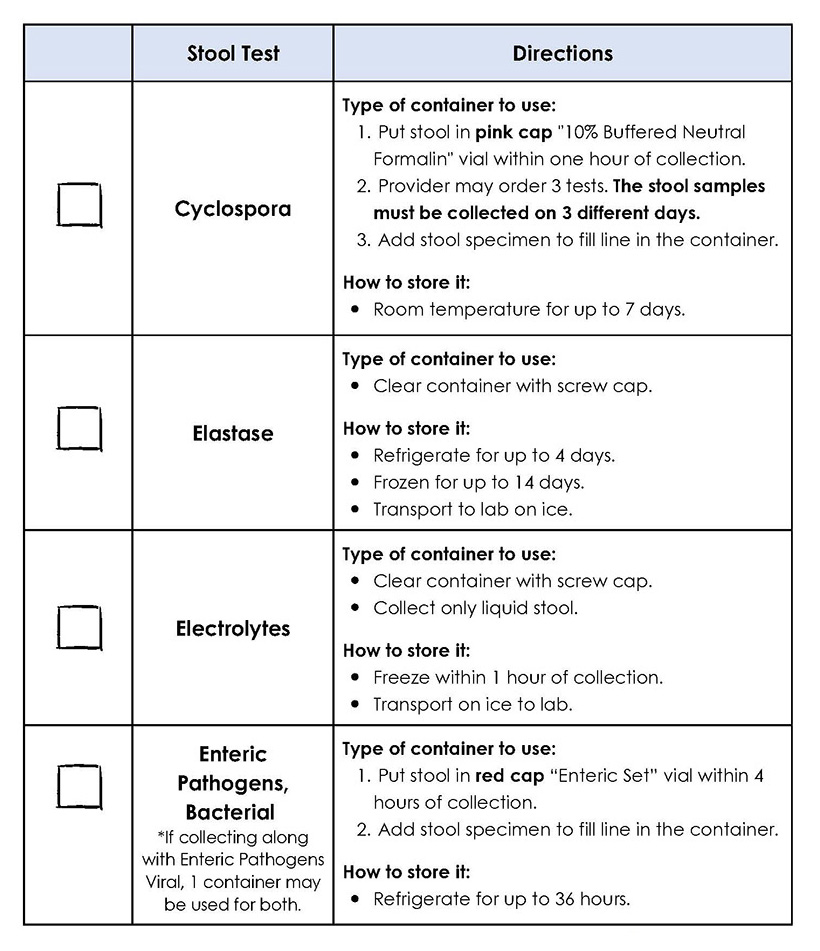
Elastase

Type of container to use: Clear container with screw cap.

How to store it:

  • Refrigerate for up to 4 days.
  • Frozen for up to 14 days.
  • Transport to lab on ice.
Electrolytes

Type of container to use:

  • Clear container with screw cap.
  • Collect only liquid stool.

How to store it:

  • Freeze within 1 hour of collection.
  • Transport on ice to lab.
Enteric Pathogens, Bacterial (Common or Uncommon)

Type of container to use:

  1. Put stool in red cap “Enteric Set” vial within 4 hours of collection.
  2. Add stool specimen to fill line in the container.
    *If collecting along with Enteric Pathogens Viral, one container may be used.

How to store it: Refrigerate for up to 36 hours.

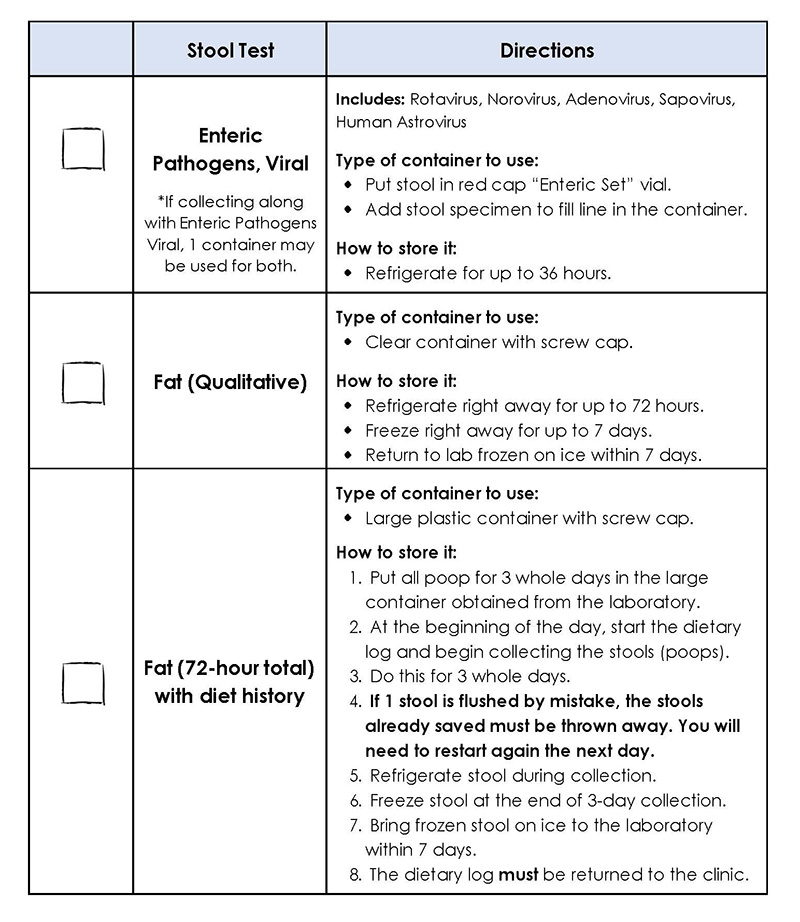
Enteric Pathogens, Viral

(Includes: Rotavirus, Norovirus, Adenovirus, Sapovirus, Human Astrovirus)

Type of container to use:

  1. Put stool in red cap “Enteric Set” vial.
  2. Add stool specimen to fill line in the container.

*If collecting along with Enteric Pathogens Bacterial, Common or Uncommon, one container may be used.

How to store it: Refrigerate for up to 36 hours.

Fat (Qualitative)

Type of container to use: Clear container with screw cap.

How to store it:

  • Refrigerate right away for up to 72 hours.
  • Freeze right away for up to 7 days.
  • Return to lab frozen on ice within 7 days.
Fat (72-hour total) with diet history

Type of container to use: Large plastic container with screw cap.

How to store it:

  1. Put all poop for 3 whole days in the large container obtained from the laboratory.
  2. At the beginning of the day, start the dietary log and begin collecting the stools (poops).
  3. Do this for 3 whole days.
  4. If 1 stool is flushed by mistake, the stools already saved must be thrown away. You will need to restart again the next day.
  5. Refrigerate stool during collection.
  6. Freeze stool at the end of 3-day collection.
  7. Bring frozen stool on ice to the laboratory within 7 days.
  8. The dietary log must be returned to the clinic.
H. pylori antigen

Type of container to use:

  • Clear container with screw cap.
  • Must be size of pea or 1 Tablespoon if liquid.

How to store it:

  • Refrigerate sample immediately up to 48 hours.
  • Frozen for up to 7 days.
  • Transport to lab on ice
Lactoferrin

Type of container to use:

  • Clear container with screw cap.
  • Must be size of walnut or 1 Tablespoon if liquid

How to store it:

  • Freeze within 24 hours of collection.
  • Transport to lab on ice to keep sample frozen.
  • Sample is stable for up to 14 days frozen.
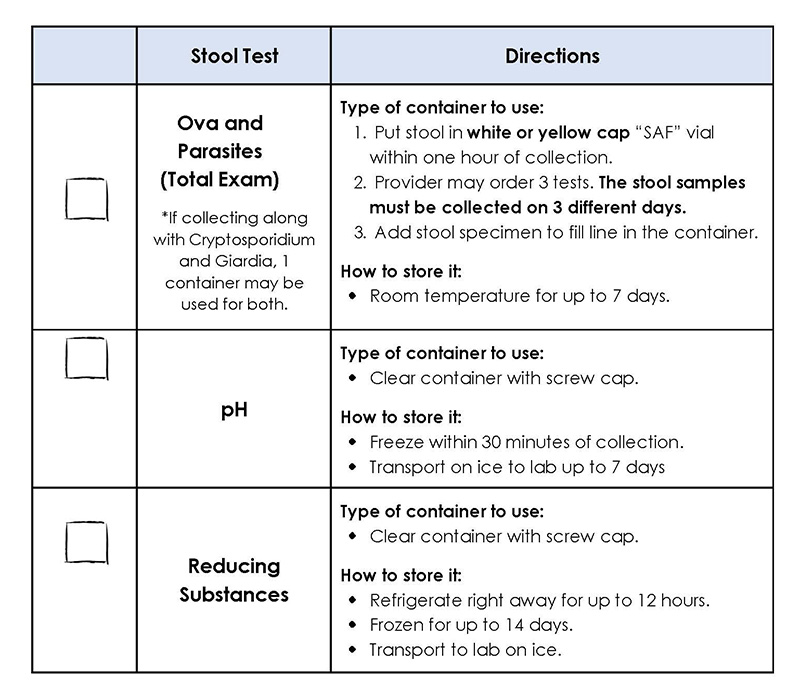
Reducing Substances

Type of container to use: Clear container with screw cap.

How to store it:

  • Refrigerate right away for up to 12 hours.
  • Frozen for up to 14 days.
  • Transport to lab on ice.
O and P (Total Exam)

Type of container to use:

  1. Put stool in white or yellow cap “SAF” vial within one hour of collection.
  2. Provider may order 3 tests.  The stool samples must be collected on 3 different days.
  3. Add stool specimen to fill line on container.

How to store it: Room temperature for up to 7 days.

pH

Type of container to use: Clear container with screw cap.

How to store it:

  • Freeze within 30 minutes of collection.
  • Transport on ice to lab up to 7 days.

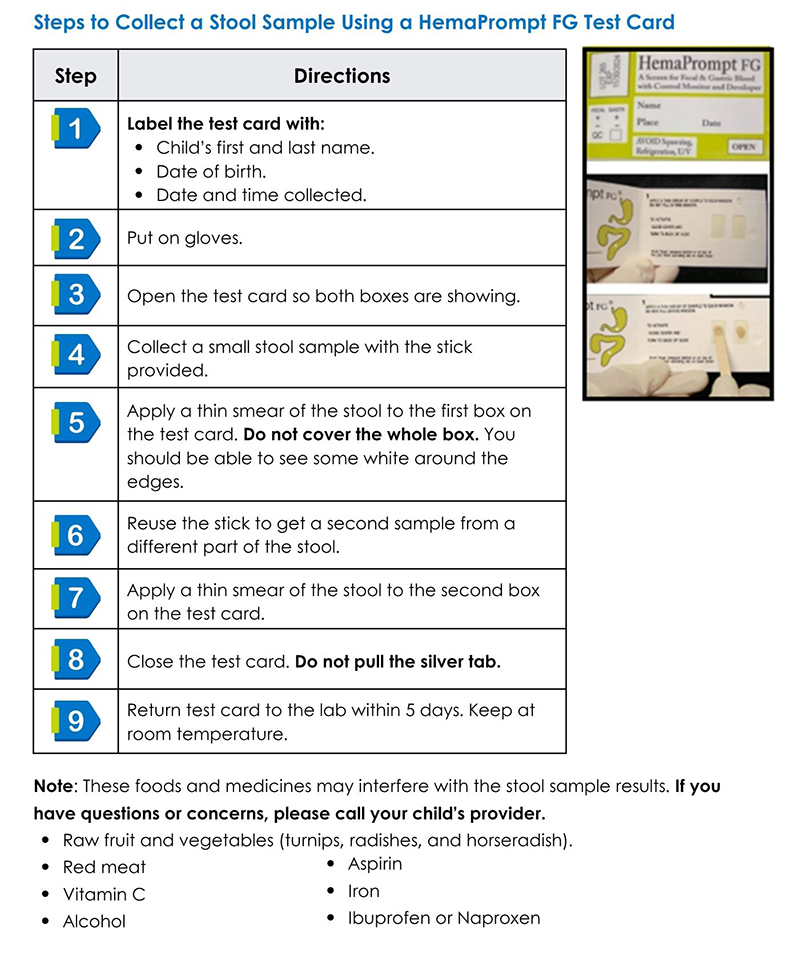
Steps To Collect a Stool Sample Using a HemaPrompt FG Test Card:

HemaPrompt FG Test Card

  1. Label the test card with your child’s name, birthday, date and time you collect the stool sample.
  2. Put on gloves.
  3. Open test card so both boxes are showing.
  4. Collect a small stool sample with the stick provided.
  5. Apply a thin smear of the stool to the 1st box on the test card. Do not cover the whole box. You should be able to see some white around the edges.
  6. Reuse the stick to get a second sample from a different part of the stool.
  7. Apply a thin smear to the 2nd box on the test card.
  8. Close the test card.
  9. Do not pull the silver tab.
  10. Return the test card to the lab within 5 days. Keep at room temperature.

Note: These foods and medicines may interfere with the stool sample results. If you have questions or concerns, please call your child’s provider.

  • Red meat
  • Raw fruit and vegetables (turnips, radishes, and horseradish)
  • Vitamin C
  • Alcohol
  • Aspirin
  • Iron
  • Ibuprofen or Naproxen

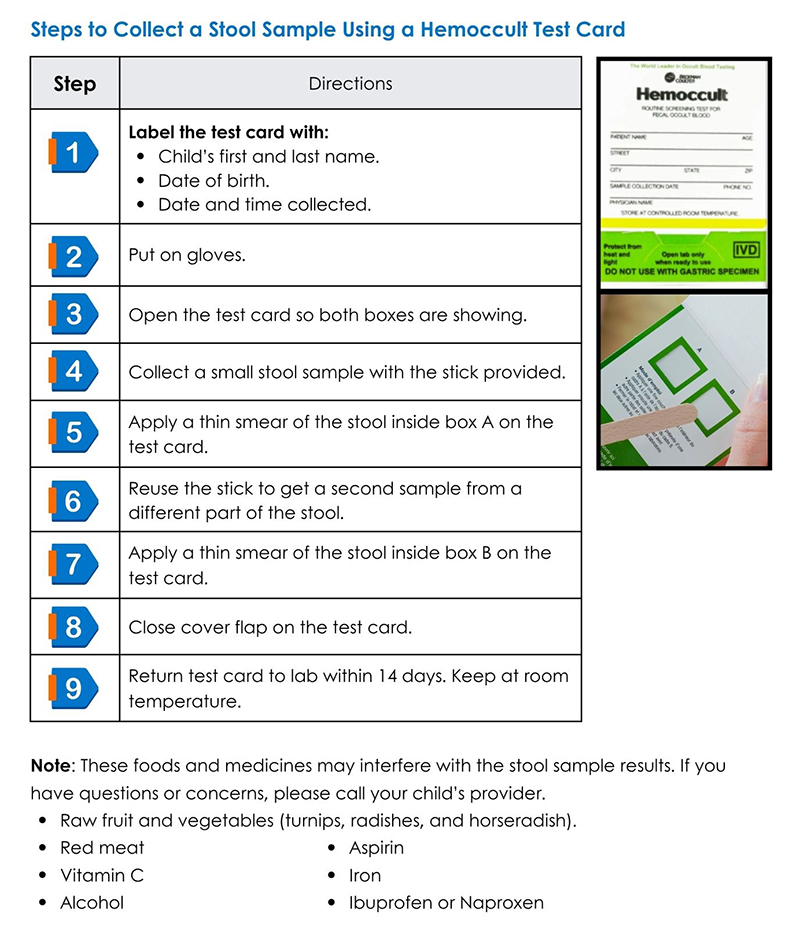
Steps To Collect a Stool Sample Using a Hemoccult Test Card:

Hemoccult Test

  1. Label the test card with your child’s name, birthday, date and time you collect the stool sample.
  2. Put on gloves.
  3. Open test card so both boxes are showing.
  4. Collect a small stool sample with the stick provided.
  5. Apply a thin smear of the stool inside box A on the test card.
  6. Reuse the stick to obtain a second sample from a different part of the stool.
  7. Apply a thin smear of the stool inside box B on the test card.
  8. Close cover flap on the test card.
  9. Return card to lab within 14 days. Keep at room temperature.

Note: These foods and medicines may interfere with the stool sample results. If you have questions or concerns, please call your child’s provider.

  • Red meat
  • Raw fruit and vegetables (turnips, radishes, and horseradish).
  • Vitamin C
  • Alcohol
  • Aspirin
  • Iron
  • Ibuprofen or Naproxen