
Milk Drops
Milk drops are a safe way to help very small babies get used to milk in their mouths starting at birth. Learn more about how to give your baby milk drops and why this is important.
Print:
The goal is to help your baby enjoy tastes of milk and learn to love eating.
What are Milk Drops?
Milk drops are a safe way to help very small babies get used to milk in their mouths starting at birth. Milk drops are small drops of milk placed on your baby’s lips. The milk can be breast milk or donor milk. Practice tasting drops of milk can help your baby to learn to love eating.
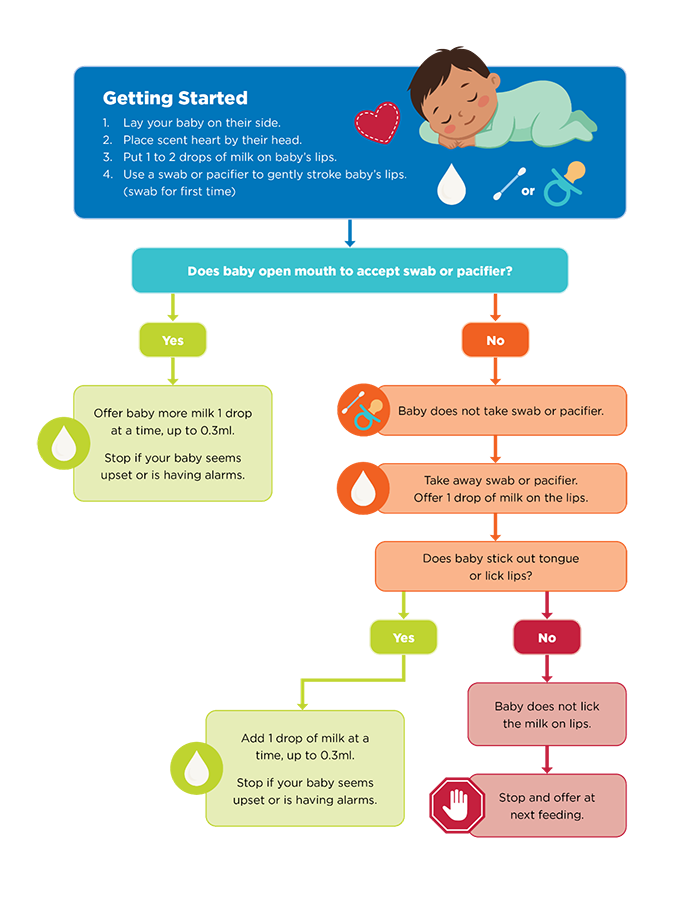
Milk Drops Step by Step
- Lay your baby on their side. Place your scent heart by their head.
- Put 1 to 2 drops of milk onto your baby’s lips.
- Use a swab or pacifier and gently stroke your baby’s lips.
- If your baby opens their mouth or roots to accept the swab or pacifier, offer your baby more milk. This will be done 1 a drop at a time onto the swab or pacifier.
- If your baby sticks out their tongue or licks, offer more milk. Add 1 drop at a time on the lips. Let your baby lick the milk.

- If your baby does not lick the milk, let your baby rest. Offer milk drops at the next feeding.
- The goal is to keep your baby happy and content. Stop if your baby seems upset or is having alarms.
Why are Milk Drops Important?
- Your baby’s premature brain is still growing. Your baby learns from everything they feel and do.
- In the womb, babies suck on their fingers and learn to swallow. They develop good memories with sucking and swallowing.
- Babies in the NICU may need a breathing tube, a feeding tube, or have their mouth suctioned. These things may not feel good.
- Milk drops can give babies a chance to enjoy using their mouth. Making good memories with milk can help your baby learn to breast or bottle feed when they are ready.
Draft Number: 2062Revision Date: August 11, 2026
This content was created to help you care for your child and/or family member. It does not take the place of medical care. Talk with your healthcare provider for diagnosis, treatment and follow-up.