
Crutch Training: Partial Weightbearing
Learn how to help your child use crutches when they are able to put some weight on their leg.
Print:
How To Use Your Crutches
Fitting crutches: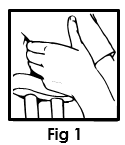
- The top of the crutch should be 3 fingers width below the armpit (See Fig 1).
- Carry your weight on your hands.
- Your armpits should not rest on top of the crutches.
Toe Touch Weight Bearing
Standing from a sit:
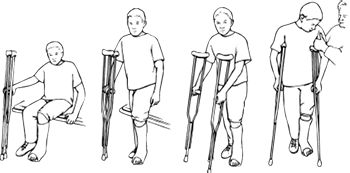
- Put the crutches on your good side.
- Put one hand on the handgrip of the crutches.
- Put your other hand on the seat or arm of the chair.
- Push up to stand using your good leg and your arms. Your healing leg can rest on the floor lightly for balance (like stepping on an egg you don’t want to crack).
- Get your balance and place the crutches below each arm so that you carry your weight on your hands.
You are ready to walk.
Walking with crutches:
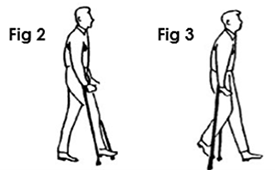
- Move both crutches forward at the same time.
- Push down on both crutches with full weight through hands (see Fig 2).
- Step past the crutches on your good leg (see Fig 3).
- Your healing leg can touch the ground for balance only (like stepping on an egg you don’t want to crack).
Toe Touch Weight Bearing - Going up and Down Stairs Using Crutches
Always take one step at a time. If the stairs have a railing, you may hold onto the rail with one hand and use the crutches or cane with your opposite arm.
Going upstairs:
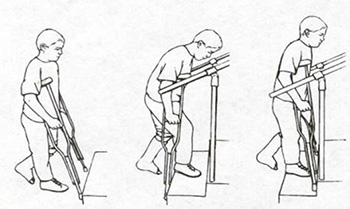
- Push down through the crutch handles and step up to the first stair with your good leg.
- Bring the crutches up
- Bring your healing leg up. The toes of your healing leg can touch for balance.
Going downstairs:
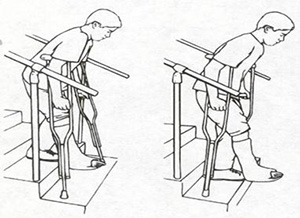
- Place the crutches on the step down.
- Bring your healing leg forward. The toes of your healing leg can touch for balance.
- Push through the crutch handles as you step down with your good leg.
Partial Weight Bearing
Standing from a sit:
- Put the crutches on your good side.
- Put one hand on the handgrip of the crutches.
- Put your other hand on the seat or arm of the chair.
- Push up to stand using your good leg and your arms. Your healing leg can have partial weight (as directed by your provider) through it.
- Get your balance and place the crutches below each arm so that you carry your weight on your hands.
- You are ready to walk.
Walking with crutches:
- Move both crutches forward at the same time.
- Push down on both crutches with full weight through hands.
- Move healing leg forward, it should touch the ground between the crutches.
- Use your arms to help take pressure off of your healing leg as your step forward with your strong leg. Only put the amount of weight through your healing leg that the doctor has approved.
Partial Weight Bearing - Going up and Down Stairs Using Crutches:
Always take one step at a time. If the stairs have a railing, you may hold onto the rail with one hand and use the crutches or cane with your opposite arm.
Going upstairs:
- Push down through the crutch handles and step up to the first stair with your good leg.
- Bring your healing leg up. Only put the amount of weight through your healing leg that the provider has approved.
- Bring the crutches up.
Going downstairs:
- Place the crutches on the step down.
- Bring your healing leg forward. Only put the amount of weight through your healing leg that the doctor has approved.
- Push through the crutch handles as you step down with your good leg.
Partial Weight Bearing - Going up and Down Stairs Without Using Crutches
Use this method when the stairs are unsafe or if you are not comfortable using your crutches.
To go upstairs:
- Sit on the stairs and bend your good leg.
- Put your hands on the next step higher.
- Push with your hands and good leg to lift your bottom up to the next step.
To go downstairs:
- Sit on the stairs.
- Put your good foot on the next step down.
- Keep your hands on the same step as your bottom.
- Push with your hands and good leg and slide your bottom down to the next step.
Safety Tips
- Watch out for slippery floors, water puddles, ice, snow and other slippery places.
- Throw rugs are unsafe. They easily catch on the tips of your crutches.
- Be careful when walking on gravel and grass.
- Wear a good tie shoe with a flat sole or tennis shoes when using crutches.
- Check the rubber tip of the crutches for cracks or excessive wear. A new one can normally be bought at a drug store, discount store, or medical supply company.
Photos courtesy of VHI
Draft Number: 1528
This content was created to help you care for your child and/or family member. It does not take the place of medical care. Talk with your healthcare provider for diagnosis, treatment and follow-up.