
Gastro-Jejunal Tube (GJ-tube): AMT G-JET®
What is a Gastrojejunal (GJ-tube)?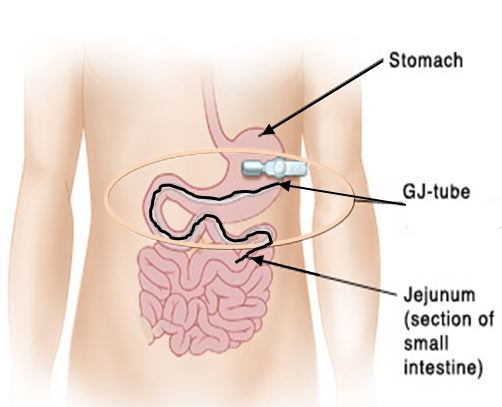
A Gastric-Jejunal tube, also known as a GJ-tube, is a special feeding tube. It is placed through the abdominal wall into the stomach and then into a part of the small intestine called the jejunum.
- The “G” means gastric (stomach).
- The “J” means jejunum (small intestine).
Why Does My Child Need a GJ-Tube?
Some children cannot eat by mouth and have a hard time with nutrition or tube feedings that go into the stomach. Feeding directly into the small intestine can help. A GJ-tube sends the food past the stomach and into the small intestine. If needed, a regular G-tube can be switched to a GJ-tube.
Reasons a child may need a GJ-tube:
- Gagging or throwing up with G-tube feeds
- Feeling sick with G-tube feeds
- Not gaining enough weight
- Slow stomach emptying
- Bad stomach pain with G-tube feeds
- Breathing problems
How Long Will My Child Need a GJ-Tube?
This depends on how well your child handles their feedings.
- If your child does well with J-port feedings, the provider may recommend trying feedings through the G-port.
- If they do not do well with G-port feedings, they will continue with J-port feedings.
- If they need J-port feedings for more than 6 to 12 months, the provider may talk to you about placing a permanent J-tube.
What is an AMT G-JET®?
An AMT G-JET® is one of the brand names of a GJ-tube. It is a button type of tube. It has a balloon filled with water to help keep the tube from falling out. There are 3 ports on the AMT G-JET®: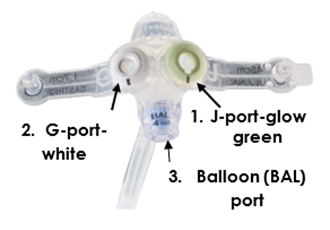
- J-port (Glow green):
- This port is used to give feeding, liquids, and medicines into the jejunum.
- G-port (White):
- Some children can keep the G-port clamped.
- Others may need it vented or placed to gravity.
- Your child’s provider will help you decide which option is best for your child.
- Balloon (BAL) port:
- This port is used to inflate the water balloon.
Helpful tips:
- Do not check or remove the water in the balloon (BAL) port, doing this can cause the button to come out.
- Do not spin the GJ-tube. This can cause the tubing to twist and move out of place. If it moves or spins on its own, that is ok.
- Visit www.childrenswi.org/gtube for videos on caring for a child with a GJ-tube.
Caring for a Child With an AMT G-JET®
Feedings
- Always use continuous feeding with the feeding pump when feeding through the J-port.
- Never give a large amount of food quickly into the intestines. They cannot handle it.
- If feedings are too fast or too big, your child may throw up, have diarrhea (poop a lot), or have stomach pain.
Medicines
- Ask your child’s provider whether each medicine should go into the G-port or J-port.
- Liquid medicine works best. Thick liquids or crushed pills can clog the tube.
- If you must use a pill, crush it into a fine powder and mix with enough water to make it smooth.
- Flush the tube before and after each medicine and between medicines.
Flushing
Flushing helps prevent the GJ-tube from clogging.
- Flush the J-port with 2 to 5 mL of water every 4 hours, even during continuous feedings.
- Flush the J-port before, between and after all medicines.
- If your child has a break between feedings, flush after the feeding ends.
- Flush the G-port with 2 to 5 mL of water daily.
G-port
- Some children can have the G-port clamped.
- Others may need it vented or placed to gravity.
- Your child’s provider will tell you which is best and show you how to do it.
Routine GJ-tube changes
- GJ-tubes should be replaced in Interventional Radiology every 3 to 4 months.
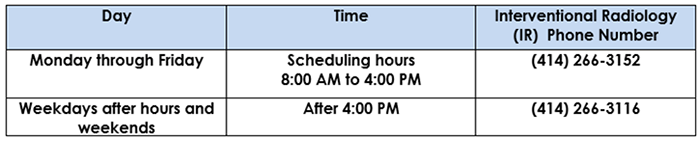
- To schedule, call Monday-Friday from 8 AM – 4 PM at (414) 266-3152.
What problems can happen with a GJ-tube?
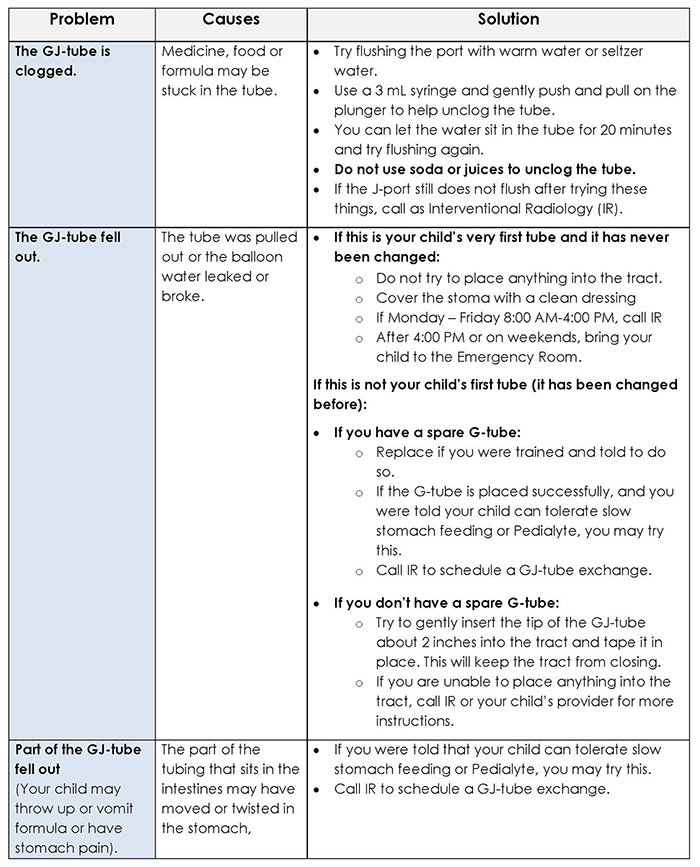
It may feel scary, but most GJ tube problems are not emergencies.
Every child has a plan for how quickly the GJ-tube needs to be fixed or replaced. This depends on your child’s age and specific medical needs. Your child’s provider will talk with you about what to do if the tube becomes dislodged, including how to manage feedings and medicines.
- Do not go to the Emergency Room unless it is truly needed.
- Call Interventional Radiology (IR) first using the phone number listed in your child’s discharge papers.
- If you go to the Emergency Room in the evening, overnight, and on weekends, the GJ tube will likely not be replaced until the next day.
- If you are unsure what to do, calling IR is the best first step.
- If your child needs a GJ tube exchange, call the numbers provided to you.
- If the problem happens during normal business hours, call right away.
- If the problem happens after hours or on a weekend, call IR the next morning to arrange a tube exchange.
In rare cases, the tube can cause a hole in the intestines. If this happens, it is a medical emergency and needs attention right away. Signs include a fever and severe stomach pain.
Draft Number: 3001Revision Date: May 1, 2026