
How to Care for Your Breastfeeding Baby
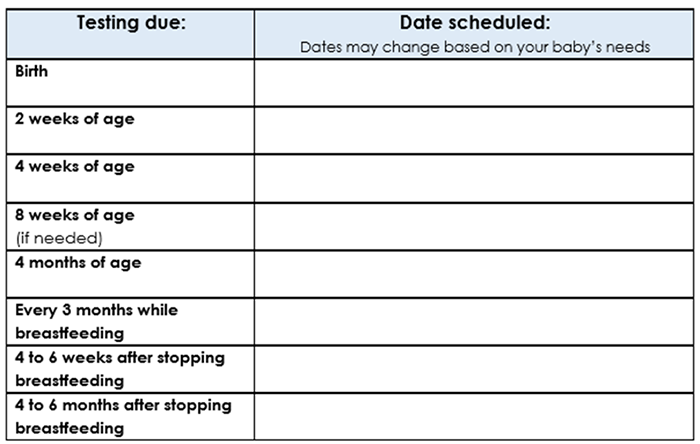
Baby’s Blood Test Schedule:
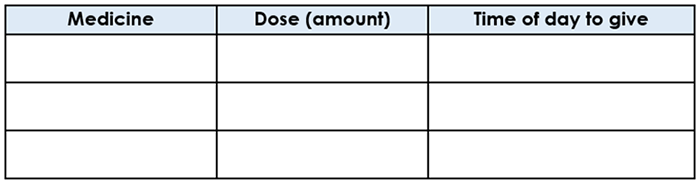
Baby’s Medicine Schedule:
As your baby grows, the dose or amount of medicine they need may change. Call for medicine refills a few days before you run out.
Your Baby’s Care Team:
Baby’s first visit with their Primary Care Provider is on: __________________________
Nurse Case Manager: ______________________ Phone number: __________________
Primary Care Provider: ______________________Phone number: __________________
Program Social Worker: _____________________Phone number: __________________
Lactation Consultant: _______________________ Phone number: _________________
Follow the info below to lower the risk of passing the virus to your baby. Talk with your healthcare provider if you have questions or concerns. We are here to support you and your baby.
For Baby
☐ Give your baby their medicines as prescribed.
- Follow your baby’s healthcare providers’ instructions.
- Your baby will need medicine while they are being breastfed or given breast milk.
☐ Keep all your baby’s lab testing visits.
- Lab testing every 3 months, or sooner if needed.
☐ Feeding help
- Wait until your baby is 6 months old before starting solid foods.
For Mom
☐ Take your medicine every day.
- Follow your healthcare providers’ instructions.
- Do not skip doses.
☐ Keep your viral load undetectable.
- This is the most important step to reduce transmission risk.
☐ Get regular lab checks.
- Viral load testing every 1 to 2 months or as directed.
Breastfeeding and Breast Care
☐ Breastfeed safely.
- Feed your baby only breast milk, unless your provider recommends adding formulas.
- Avoid mixing breast milk and formula. Mixed feeding (breastmilk + formula) can increase the risk of transmission.
☐ Watch for mastitis. This is a breast infection, and the signs include:
- Breast pain, redness, warmth.
- Fever or flu-like symptoms.
☐ If mastitis happens:
- Pump milk from the affected breast (pump and dump)
- Do not breastfeed from that side until it improves.
- You may:
- Throw away the pumped milk (pump and dump).
- Pump and flash-heat the milk from the affected breast before feeding it to your baby.
- Flash heat is a way of heating pumped breast milk to make it safer for your baby. This process helps reduce the amount of virus, while keeping most of the milk’s nutrients. Ask your care team for instructions on how to flash-heat, if needed.
Stopping Breastfeeding
☐ When you are ready to stop breastfeeding, wean slowly over 2 to 4 weeks.
- Do not stop suddenly, as this can cause:
- Engorgement (overfull, swollen, and painful breasts).
- Increased risk of mastitis.
☐ After you stop breastfeeding, continue your baby’s medicine for 4 weeks.
- Follow the provider’s recommendations.
☐ After you stop breastfeeding, your baby will need follow-up lab testing.
- Labs at 4 to 6 weeks after breastfeeding stops.
- Labs again at 4 to 6 months after breastfeeding stops.
Draft Number: 1706Revision Date: June 1, 2026