

Home Run Care: Not Even a Broken Arm Could Slow Jack Down
On the kind of sunny but frigid April day that seems to mark the beginning of little league baseball season in Wisconsin, you could have witnessed a bit of a rout.
12-year-old Jack pitched four hitless innings, and, after falling behind on an 0-2 count in his first at bat, connected on an outside fastball that he rocked over the right field fence. Watching him round the bases, seeing his teammates mob together at home plate on the way to leading them to an 11-1 win, you’d have no idea they had just lost to this same opponent two days earlier. More importantly, you’d have no idea how twisty the path was that led Jack to this moment.
It began as a normal school day in September 2025: a freewheeling afternoon recess, the practicing of front handsprings in the grass with a gymnast friend. And suddenly Jack, then 11, hit the ground the wrong way.
“It was quite the spectacle at school,” said Amanda, Jack’s mom. “Apparently the kids around him could hear it. When I walked in and saw his arm all noodle-shaped, it was a little shocking, to say the least.”
There are many firsts in parenting. And then there is the first broken bone.
A call from the school nurse is not always an emergency, but sometimes you hear, “Can you get here quickly?” Jack had a displaced fracture of his forearm, the ulna and radius bones, and it was clearly time for a doctor.
But at the nearest hospital, Amanda learned the hard way that doctors who see adults really prefer not to set children's bones.
“That's kind of a funny thing — if your kid ever breaks a bone, don't even go to the local hospital,” said Amanda. “We were at that hospital for two-plus hours just to get a temporary cast and get sent to Children’s Wisconsin.”
The Importance of Pediatrics
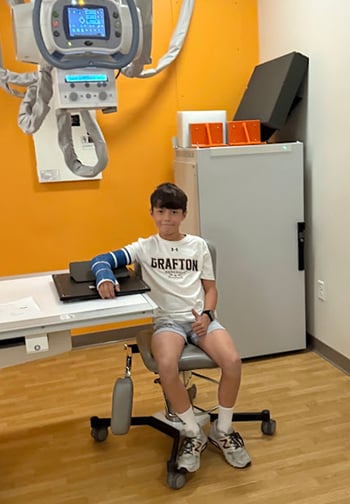 The fragile bones and still-growing bodies of kids often call for the expertise of pediatric specialists like John Erickson, DO, a Pediatric Orthopedic Surgeon at Children's Wisconsin.
“The benefit of coming to Children’s Wisconsin is it's much more likely going to be the only intervention you need,” said Dr. Erickson. “We see thousands of pediatric fractures each year It's going to be set perfectly straight.”
When Jack got to Children’s Wisconsin, his first stop was the Emergency Department. Doctors there assessed his injury and pain level and gave him some medication to make him comfortable.
“Everybody's calmness helps you feel a little calmer,” said Amanda “I don’t think Jack was in shock, but he was kind of stunned.”
In the ED, the family learned that because the break was displaced, it needed to be realigned. In a procedure known as a reduction, Dr. Erickson supervised as the broken bones were manually moved into place by Daniom Tecle, MD, an Orthopedic Surgery Resident.
“We were joking with the nurse because they obviously don’t want the parents to stay in the room when the bone gets set,” said Amanda. “We were chatting like, ‘What's that like?’ Can you hear it reset? Does it just pop right back in?’”
The procedure is obviously quite painful, so Jack was given a mild sedative. The nurse told him to choose a dream. Jack said he wanted to catch a home run ball at a World Series game. And then he dozed off. Amanda and her husband, Blair, stepped out to the waiting room.
After about 30 minutes, a nurse came out and brought them back. Jack was slowly waking up, his right arm now covered from the wrist to the shoulder in a blue cast.
“He had a hard time speaking at first, but after a few minutes he was back,” said Amanda. “We asked him, ‘Did you catch the ball? Did you go? Were you there? And he's like, ‘Yes!’ He also said he had a dream that was like The Magic School Bus, where he was inside his own arm watching as 1,000 microscopic doctors lifted his bones up and shoved them back together.”
Within an hour Jack was ready to go home. His mom thought he’d need some time to rest. Jack had other ideas.
"He went to bed and I thought he would stay home the rest of the week,” said Amanda. “But he woke up perky as can be, he went to school and got the cast signed by everybody.”
A Lesson in Resiliency
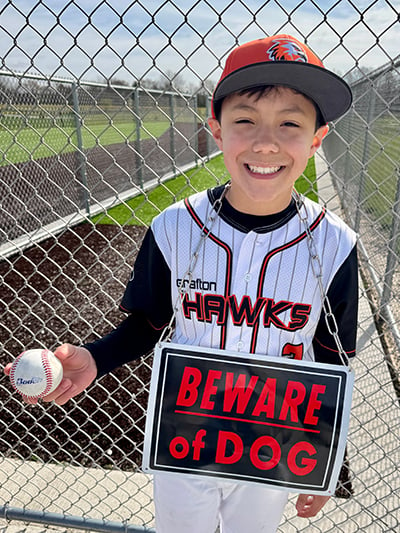 Jack was in the full-arm cast for three weeks — when his first cast was re-wrapped after a week, he was able to choose more appropriate orange and black, the colors of his Grafton Hawks baseball team — and then a forearm cast for three more weeks. He was forced to miss the rest of the fall football season, forced out of the winter basketball season and even forced to learn to take notes in school left-handed. But he refused to let any of it get him down.
“He was like, ‘I'm going to write for myself. I'm going to do all the things myself,’” said Amanda. “I got notes from a bunch of his teachers about how impressed they were with his determination not to let it slow him down. So, it's a weird thought to say but I'm grateful that he went through that kind of traumatic experience.”
And just nine months later, Jack was standing at home plate being mobbed by his teammates.
“In sports, my husband always talks about resiliency, having a good attitude and coming out of hardships stronger than ever. What in the moment was a scary big thing turned out to go as smoothly as we could have hoped for. And I feel like Jack was a different kid after. You would never know anything had happened,” said Amanda. “It was great to see him tap into that resilience, remember that he’s been through worse — a snapped forearm — and come out stronger. Nothing seems like such a big deal after going through that.”
In hindsight the break feels like a hard-won lesson in inner strength, in learning from setbacks, and figuring out how to tackle — or hit — adversity. It won’t be the last time the family applies the bigger principles of Jack’s fall. Or the practical ones.
As luck would have it, in February, their 10-year-old daughter broke her finger at basketball practice.
“When I picked her up, she clearly had a broken finger,” said Amanda. “I was like, well, we'll just go right to Children’s Wisconsin.”
They did — and she got her cast removed just in time to make it back for the season-ending tournament.
Children's Wisconsin Resources
Written by
Writer
Related Stories
No related articles found.