
How Children’s Wisconsin Is Partnering With Schools To Transform Student Health
As Wisconsin students went back to school this fall, they had more than backpacks stocked with blank notebooks and freshly sharpened No. 2 pencils. They also had a powerful ally supporting their health and academics: Children’s Wisconsin.
With a commitment to reaching kids where they live, learn and play, Children’s Wisconsin has a long history of partnering with schools across Wisconsin and beyond to advance a culture of student health and wellbeing.
“We support our school partnerships in a multitude of ways, always keeping the student’s health and safety at the center,” said Bridget Clementi, Vice President of Community Health at Children’s Wisconsin. “We recognize that while schools’ primary focus is on academic education and we focus primarily on health, when we partner together, we have the opportunity to improve both health and academic outcomes for kids.”
Here’s a look at just a few of the many unique partnerships, programs and services Children's Wisconsin has with area schools.
Mental Health: Providing Direct Care at School
 Sometimes the students who most need mental and behavioral health support are least able to get it — it’s not easy to keep a weekly therapy appointment if your family juggles multiple jobs, lacks reliable transportation or faces homelessness or other significant stressors.
That’s why Children’s Wisconsin has partnered with school districts to offer school-based therapy for more than a decade.
“We decided to move with purpose in the school space because kids spend so much of their time in school,” said Jenny Miller, LPC, Manager of Children’s Wisconsin School-Based Mental Health Services. “The families we see have a lot of barriers to access care. The kids we see would not be getting mental health services if we didn’t have a clinic in their school.”
The program serves 85 K-12 schools across the state, ranging from urban schools in Milwaukee, Racine and Madison, to rural areas around Eau Claire, Stevens Point, Marshfield and Wausau. Over the last two school years, the program served more than 2,900 students and conducted more than 48,000 psychotherapy sessions.
School-based therapists provide individual, group and family therapy along with teacher consultation, professional development for staff, parent programming and more. The most common issues treated are trauma, anxiety-based disorders and depression.
School-based therapists collaborate with school personnel to ensure that the students most in need of services receive access to care. Therapists also use mental health screening tools to support students, including checking all adolescents for suicide risk.
“We’re able to catch kids that are not on anybody’s radar a lot quicker because we’re looking for that,” said Brooke Briscoe, LMFT, Director of Mental and Behavioral Health at the Craig Yabuki Mental Health Center who oversees school-based mental health statewide. “We’re then able to develop plans with the kids, schools and families. We are catching problems before they expand into bigger problems.”
The mere presence of a school-based therapist helps break down stigma around mental health as students greet their therapist in the hall and refer friends who are struggling. Sometimes a student will even bring a therapy tip back into the classroom to share with peers.
“They’re teaching and coaching other kids,” said Jenny, “which is really kind of magical to see.”
Athletic Training: Caring for Kids at School and on the Sidelines
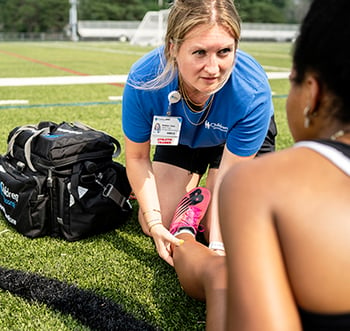 In 2020, Children’s Wisconsin saw a need to provide school-based athletic training services and stepped into the gap. Today, licensed athletic trainers are based at 29 secondary schools around Southeastern Wisconsin, serving approximately 8,000 student-athletes annually at no cost to families.
The athletic trainers keep regular hours at their assigned school and provide emergency coverage on the sidelines of school athletic events. They help with everything from injury evaluation and rehabilitation to health education and emergency preparedness planning.
“They’re a health care resource in the schools,” said Kat Tase, LAT, OTC, PES, Manager of Orthopedics and Sports Medicine at Children’s Wisconsin. “We provide athletic trainers to adolescents at such a vulnerable point in their development, and to be able to help direct them to really good quality care and resources to help set them up for success long-term is huge. Having a professional that’s embedded into their school day and environment can be really impactful.”
When needed, athletic trainers connect students to specialized services at Children’s Wisconsin, including sports psychology, nutrition and treatment for chronic conditions.
“What I think is different about Children’s Wisconsin is our approach is about the whole child,” said Kat. “If our staff notice a young athlete has uncontrolled asthma or any sort of health-related condition that might be exacerbated with sport participation, they can help bridge that gap in the health care system.”
Sometimes teens can be more likely to listen to health advice from an athletic trainer with whom they have developed a relationship. And the impact can last beyond graduation, exposing students to new career possibilities.
A high school student who had worked with one of the Children’s Wisconsin athletic trainers recently sent an email about her plans to pursue nursing. “You guys inspired me to go into health professions and now I want to help others,” she wrote, “and it’s all because of my interactions with you.”
E-Learning: Educating Students on Health and Wellness
 There are many ways to measure the impact of the Children’s Wisconsin e-Learning Center, but the most meaningful testaments come directly from students and teachers who have participated in the center’s programming.
“Other students aren’t as mean, and more students are nice,” wrote a student whose school participated in a bullying prevention campaign.
Since 2006, the e-Learning Center has delivered evidence-based lessons on bullying prevention, mental and emotional health, nutrition and physical activity, alcohol and other drug use prevention, and safety and injury prevention directly to schools. As kids’ health needs have evolved, so has the content, from vaping prevention to a new cyberbullying minicourse for high schoolers.
“It’s all about helping kids make healthy choices so that they can grow into healthy adults,” said Clay Anton, an e-Learning Specialist at Children’s Wisconsin. “And if they are making good choices, they can perhaps avoid some of the more traumatic things that can happen if they experiment with drugs or alcohol, or they’re involved in a bullying scenario where it escalates and causes great harm to a young person.”
The e-Learning content reaches more than 100,000 K-12 students annually, including students in all 72 Wisconsin counties and in other states and countries.
It’s unusual for a pediatric health system to develop and offer such a robust suite of interactive e-Learning resources, which is why educators from around the world have turned to Children’s Wisconsin’s free, web-based content. “We are the leading pediatric institution that does this kind of work,” said Clay.
In addition to e-Learning content, Children’s Wisconsin offers schools staff training, parent/caregiver awareness materials and stipends to support implementation of school-wide campaigns. All resources and supports are provided at no cost to schools.
“Schools have a number of priorities on their plate,” said Katie Horrigan, MPH, Director of Community Education and Outreach at Children’s Wisconsin. “And a lot of times those are those core subjects that they’re tested on. But health is still a really important part of everything that kids do because if kids aren’t healthy, they cannot learn.”
Project ADAM: Ensuring Schools Are Ready for Cardiac Emergencies
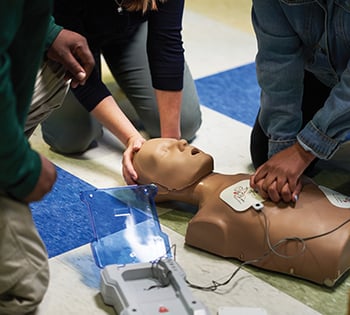 In May 2026, a staff member at Hillcrest Primary School in Shawano, Wis., collapsed due to sudden cardiac arrest. Fortunately, school staff had recently trained for just such an emergency while earning the “Heart Safe School” designation through Project ADAM (Automated Defibrillators in Adam’s Memory), a national program that got its start at Children’s Wisconsin. The school’s Medical Emergency Response Team rushed into action, performing CPR and automatic defibrillator (AED) care until emergency medical personnel arrived on the scene.
“Who would have imagined we would face a situation like this so soon after completing the steps to become a Heart Safe School?” a Shawano School District nurse wrote in an email to Project ADAM afterward. “I truly believe our team was better prepared for this type of emergency because of Project ADAM and the drills we practiced.”
The happy ending in Shawano is one of more than 300 saves attributed to Project ADAM since the program was founded in 1999. More than 2,800 new schools partnered with Project ADAM in 2025, with more than 7,000 schools nationwide earning the Heart Safe designation since 2004.
Project ADAM was started by Patty and Joe Lemel after their 17-year-old son, Adam, died from sudden cardiac arrest during a school basketball game. In the wake of Adam’s unexpected death, Patty and Joe committed their lives to doing whatever they could to make sure no one else would suffer the same fate.
Students aren’t the only one who benefit from school-based AEDs and emergency training. School staff, parents and other visitors have been among those saved.
“Schools really are the hub of the community, and it’s a place where we can make a big difference,” said Alli Thompson, MBA, the Project ADAM Administrator who oversees the Wisconsin program and national network of affiliates. “Schools really appreciate the partnership. We want to empower schools and be an expert resource for them.”
A Full Spectrum of Support for Students
Children’s Wisconsin engages with schools in many other ways, too — from asthma prevention and oral health services for schools to delivering school nursing and physical therapy services.
Children’s Wisconsin is committed to investing its resources to ensure children and families receive the care, education and support they need to be healthy and well. In 2025, Children’s Wisconsin invested more than $201 million in community benefit activities that respond to these and other community health needs and aim to improve the health and well-being of residents across Wisconsin.
“Children’s Wisconsin is proud to invest in these and many other programs and services that work closely with schools to promote kids’ health and well-being,” said Jen Mance, Director of Advocacy and Community Benefits at Children’s Wisconsin. “We’re committed to investing our resources, providing staff and leveraging our expertise alongside our partners to contribute to healthier kids, schools and communities.”
Children's Wisconsin Resources

Written by
Writer
Related Stories
No related articles found.