
What to Expect in the Hospital When Your Child is Admitted for an Eating Disorder
Your child is in the hospital because they have hurt their body from not eating well. As your child gets the food they need, your child’s medical problems will get better and return to normal. This includes heart rate, blood pressure and blood levels. Once these medical problems improve, your child will be discharged to get treatment outside of the hospital.
How Long Will Your Child Stay?
Most often, the stay is 7 to 10 days. We plan for discharge as early as possible. Your child needs to be medically stable and have a plan for treatment after the hospital. Sometimes programs and providers may have wait lists before your child can be seen.
Goals of the Hospital Admission
- Look for and treat medical problems due to malnutrition.
- Help your child eat better to meet their body’s needs and stay healthy.
- Create a treatment plan for recovery after leaving the hospital.
Treatment Components
- Full exam and lab tests.
- A treatment plan made just for your child with vitamin and mineral supplements.
- Keeping track of how the heart is working and how your child is breathing.
- Looking at your child’s diet and making a plan for eating.
- Care by a psychologist to help your child and family learn about disordered eating
- Seeing if medicine given by a psychiatrist would help.
Team Members
- Adolescent Medicine
- Hospital Medicine
- Psychiatry if needed
- Nursing
- Social Work
- Nursing assistants or sitters
- Case Management
- Child Life
- Art Therapy
- Music Therapy
- Pet Therapy, if desired
- Spiritual Care if desired
- Specialists if needed
- Clinical Nutrition
Vital Signs
Staff will check your child’s vital signs each morning before getting out of bed and as needed throughout their stay. This includes heart rate, temperature, and blood pressure.
Labs
Your child will have their blood drawn every day. This is to check electrolytes in the blood like potassium, magnesium, and phosphate. If they are too low, supplements can be given to your child.
Weight
Your child will be weighed once daily in the morning with their back to the scale. Specific weights and calorie information will not be shared with your child. This information can be shared with caregivers outside the room. We recommend not sharing numbers with your child.
Meals and Snacks

- Food and rest are medicine. Your child will need to eat and drink all of their nutrition at every meal and snack.
- Meals and snacks will be scheduled. Your child will be expected to eat or drink 3 meals and 3 snacks.
- 7:45 AM: Breakfast
- 10:00 AM: Morning snack
- 12:30 PM: Lunch
- 3:00 PM: Afternoon snack
- 6:00 PM: Dinner
- 9:00 PM: Evening snack
- Feeding therapies may include Naso-Gastric (NG) Tube feedings if meals or supplements are not taken. It is critical that your child gets all their food for each day to correct their medical problems and re-nourish their body.
- Your child is not allowed outside foods. This is because we carefully write down all food and drinks taken.
- No bathroom use or walking for 60 minutes after meals and 30 minutes after snacks. Time starts after finishing the supplement.
- We ask caregivers to eat with their child and provide support during mealtimes. Any extra food should not be left in the room. There is a parent lounge and cafeteria for the caregiver to use.
- Your child will get a goal for how much to drink so they don't drink too much or too little water.
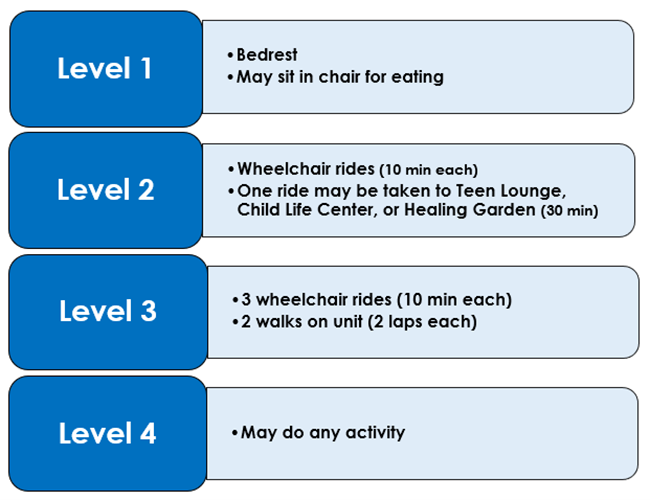
Activity Levels
Based on your child’s medical condition (vital signs and symptoms), your child will be placed on one of these activity levels. Most patients start at Level 1.
Privileges
We provide a strict behavior plan to help your child to meet their own eating goals.
- Your child will always be watched during activities. This includes eating, The bathroom door should stay cracked open when in use. Your child will have an in-person or video sitter. Some patients may only be watched during meals and snacks.
- It is important for caregivers to take part in the care during their child’s hospital stay.
- Cell phone and computer use may be limited if a behavioral plan is developed between the treatment team and your family. Cell phone and computer use is not allowed in the first 24 hours.
- The hospital phone may be used to call family members.
- School work may be completed for up to 3 hours a day. School work is not allowed for the first 24 hours.
- Watching food videos or shows is not allowed.
Resources for Families
Book suggestions for parents:
Help Your Teenager Beat an Eating Disorder
by James Lock and Daniel Le Grange

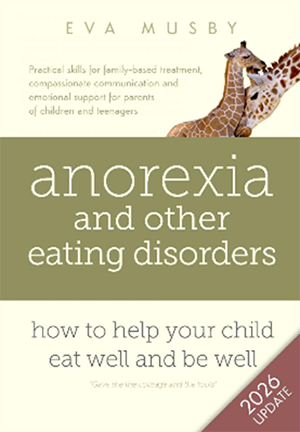
Anorexia and Other Eating Disorders: How to Help Your Child Eat Well and Be Well
by Eva Musby
Websites:
Draft Number: 1654Revision Date: May 1, 2026