
Retinoblastoma: Intra-Arterial Chemotherapy (IAC)
For children with retinoblastoma, one way to destroy cancer cells is with Intra-arterial chemotherapy (IAC). The Retinoblastoma team may decide this is a treatment your child should receive.
What Is Intra-Arterial Chemotherapy (IAC)?
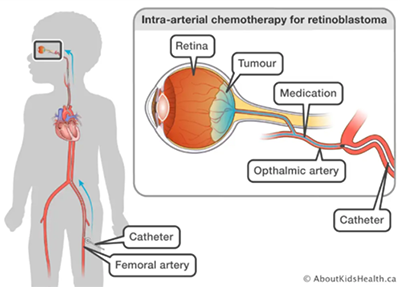
Intra-Arterial Chemotherapy (IAC) is a way to give medicine (chemotherapy) to treat fast growing cells. It is used to treat tumors that affect 1 eye or for tumors that have returned. The chemo is put into the ophthalmic artery (artery of the eye). This helps protect normal cells in the body. This is the best way to get the medicine directly to the tumor. The IAC procedure may be performed every 4 weeks, for up to 6 cycles.
©2004-2025 AboutKidsHealth
What Happens During This Procedure?
- It is done in the operating room while your child is asleep. Your child will be given medicine to help them be asleep. It takes about 4 hours to perform the IAC.
- A needle is inserted into an artery in the groin. This is most often the femoral artery.
- A catheter is inserted and threaded up to the ophthalmic artery (artery of the eye) where chemo is given.
- When complete, the catheter is removed from the groin. Pressure is applied. A dressing is placed over the site.
Caring for Your Child After the Procedure
Following the procedure, your child will be admitted to the Pediatric Intensive Care Unit (PICU) for 4 to 6 hours. After this time, your child may be taken to East 5 (HOT Unit) or discharged home.
- Your child needs to lie flat on their back for 4 to 6 hours.
- Your child must avoid moving the leg that the catheter was removed from. This will help prevent bleeding at the insertion site in the groin. This may require medicine to help keep your child from moving.
Draft Number: 2236