
The Facts on Child Pedestrian Safety
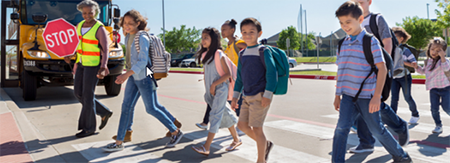
Risk Factors for Child Pedestrians:
- Speed: As the speed of the vehicle increases, the chance of survival when struck decreases.
- Kids’ development: Kids’ depth perception is not as accurate as adults’.
- Distractions like cell phones and headphones or earbuds. Remind children to remove all distractions when walking so they stay focused on the road.
Age 10 To Walk Alone
According to the American Academy of Pediatrics (AAP), children are not ready to walk alone until about fifth grade or around age 10. From a developmental standpoint, 10 is the age most children can judge the speed and distance of oncoming cars.
Teach and Reteach Children To Be Safe Pedestrians.
While young children need to learn pedestrian safety, older children need reminders too. Teach children and teens of all ages to use crosswalks, read traffic signals and stay distraction free while on the road.
Be Safe and Be Seen.
- Wear bright or light-colored clothing and reflective materials.
- Use a flashlight or other light up devices to help make you more visible at night.
- Walk in well-lit areas.
Be Alert and Aware.
- Put down your technology while crossing the street. Do not wear headphones or look at your phone while crossing the street.
- Watch for vehicles backing out of driveways and alleys. Make sure you make eye contact with the driver before crossing.
According to Safe Kids Worldwide, 385 children ages 0 to 19 died and another 9,257 were injured as pedestrians in motor vehicle crashes in 2021.
Street Smarts

Children’s Wisconsin offers a free online e-learning program for schools called Street Smarts that teaches pedestrian safety for kids in grades 3 to 4 and grades 5 to 6. Let your school and teacher know about this program.

Draft Number: 2046Revision Date: February 1, 2026