
How to Place a G-tube if the GJ-tube Falls Out
If your child's GJ-tube comes out, it will need to be replaced in the hospital. A MIC long G-tube will need to be put in the opening until this procedure can be done. The opening is also called the stoma or tract which is where the tube goes in. Learn the steps to place the MIC long G-tube at home.
Print:
It is important to know how to place a G tube if the GJ tube comes out. This helps keep the opening in the belly (the stoma) from getting smaller. You will be given a button G tube to keep at home. You will be shown how to put this tube in if it is ever needed. This G tube is only a temporary tube. It should be used only until your child’s GJ tube can be replaced in Interventional Radiology (IR).
Follow These Steps To Place a G-Tube:
- Collect your supplies:
- Button kit: Make sure it is the same size as the G portion of the GJ tube your child already has. The FR (French) size and the cm (centimeter) length should match.
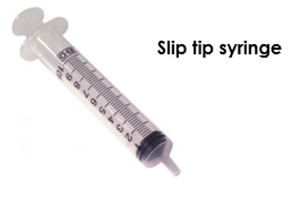
- Slip tip syringes: It is best to have 2 syringes. The kit only comes with one.
- Sterile, distilled, or bottled water: Use this to fill the balloon. Do not use tap water or saline.
- Wash your hands with soap and water.
- Get a new button ready.
- Open the kit and get the new button ready.
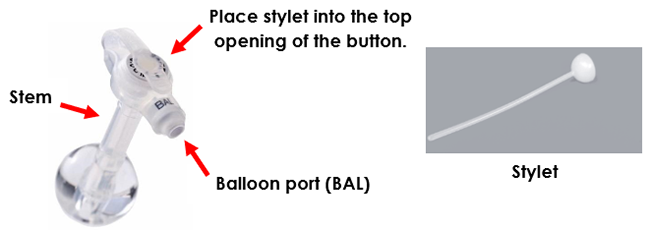
- If your kit has a stylet, place it into the top opening of the button. This makes the stem (the part with the balloon) firmer and easier to place in your child’s belly.
- Put a little lubricant on the tip of the stem.
- Pull clean water (sterile, distilled, or bottled) into the slip tip syringe.
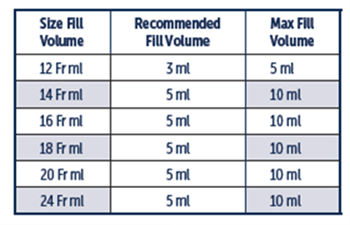
- The amount of water needed can vary. Use the amount your child’s provider recommends or follow the chart below.
- Place the button.
- Gently push the lubricated button into the opening on your child’s belly.
- Do not force it. A little pressure is okay.
- Wiggling or gently twisting the button can help.
- If your child is tightening their belly or crying, have them take a deep breath. For babies, wait for a pause or a breath between cries.
- Stop and call your child’s nurse or provider if you cannot get the button in.
- Hold the button in place and remove the stylet (if used).
- Put the slip tip syringe with new water into the balloon port.
- Push the plunger until all the water goes into the balloon.
- Keep your thumb on the plunger while you remove the syringe from the balloon port.
- Remove the slip-tip syringe.
- Gently push the lubricated button into the opening on your child’s belly.
- Gently pull up on the button.
- Wipe away the extra lubricant from the skin.
- Turn or spin the button in the tract.
- Check that the button is in the right place.
- Attach the extension set to the button
- Gently pull back on the syringe plunger until you see stomach juices or formula. This shows the button is in the stomach and in the correct place.
- If you are unable to pull back any gastric juices or formula, do not use the tube. Keep the tube in place until a GJ-tube is able to be replaced.
What if You Have Trouble Placing the G-Tube?
- If you are having a hard time putting the G-tube in, stop right away.
- Never force the tube into the tract.
- Call Interventional Radiology (IR) or the provider who manages your child’s feedings for help.
- You will need to come to the Emergency Room if you cannot get a tube back into the tract or if this happens after hours.
- If your child cannot safely go through the night without feedings, fluids, or medicines, call the provider who manages your child’s feedings for guidance.
Draft Number: 3070Revision Date: June 1, 2026
This content was created to help you care for your child and/or family member. It does not take the place of medical care. Talk with your healthcare provider for diagnosis, treatment and follow-up.