

Blake’s Walk-Off Win: How a Simple Headache Became a Life-Or-Death Situation
On a warm, early summer day in 2024, 7-year-old Blake found himself on a sun-soaked baseball field in Cedarburg, Wisconsin. In a blur of high fives and cheers — caps and gloves littering the infield — Blake’s team huddled together celebrating a championship.
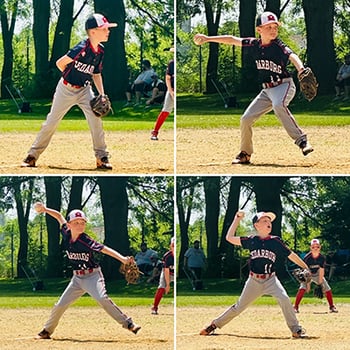
During the 13-3 victory — and throughout the undefeated season — Blake played first base, second base and pitcher. It was an amazing accomplishment for any 7-year-old. But for Blake, who just a few months prior was stuck in a hospital bed unable to move, it was a truly remarkable victory.
Trusting Your Gut
It all started on Monday, Jan. 22, 2024. Around 11 a.m., Rebecca, Blake’s mom, received a call from the school nurse. Blake was complaining of a headache. Nothing too concerning, but his teacher could tell something was wrong and insisted they call her.
Thankfully, Rebecca was working from home that day and only lives about 10 minutes away, so she hopped in the car to go get him. When she arrived at the school, Blake was vomiting excessively. Having just returned from a week-long family vacation in Florida two days earlier, Rebecca assumed Blake had caught a stomach bug or something on the plane.
Back at home, however, she started to notice some unusual behavior.
“A little time went by and then my mom radar kind of went off,” she said.
Blake, who always sleeps with a shirt on, had taken his shirt off and crawled under a blanket. He wasn’t interested in watching TV. And then he started throwing up again. He’d doze off, wake up to throw up, and fall back asleep.
Rebecca called his pediatrician. Luckily, as it would turn out, they didn’t have any open slots to see him that day, so the nurse suggested she take Blake to Children’s Wisconsin.
No Time To Wait
 At the Children’s Wisconsin Emergency Department, Blake had now developed a fever. A nurse gave him an Advil, but he immediately threw it up. As the doctor was discussing whether or not to get a CT scan, Blake started screaming in pain. And then he went limp.
“I realized he wasn’t falling asleep,” said Rebecca, “he was passing out.”
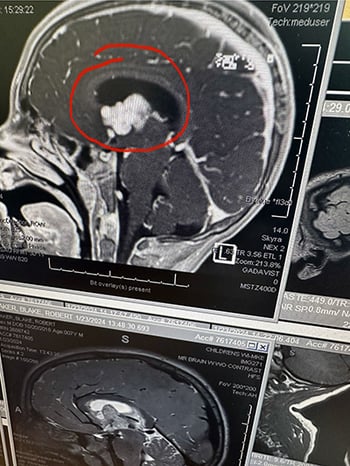
Blake was rushed to get a CT scan. As Rebecca held Blake’s hand, comforting him during the test, she noticed the techs behind the glass talking on the phone and looking concerned. Immediately following the CT scan, now in a different hospital room, a neurosurgery resident showed Rebecca the scan and told her Blake’s head was filling with fluid.
“I remember he had this piece of paper that gave consent to go into surgery,” said Rebecca. “He was very matter of fact, which I appreciated. I don’t remember his exact words, but he made it very clear that Blake needed to go into brain surgery right away, that if we didn’t sign that piece of paper to allow Blake to have the surgery, he was going to die.’”
“Blake had obstructive hydrocephalus. A tumor in his brain was blocking spinal fluid from exiting his brain’s ventricles, causing pressure to build up,” said Elsa Arocho-Quinones, MD, FAANS, FCNS, Pediatric Neurosurgeon at Children’s Wisconsin. “It required a very urgent intervention. It was a life-threatening situation.”
Rebecca, of course, signed the paper and Blake was rushed back to surgery. She then called her husband, Eric, who dropped everything and came immediately.
“We were both in shock,” said Rebecca.
This surgery, what would be later known as his first surgery, was done to relieve the pressure building in his head. It was just a temporary fix while they figured out the full extent of what was going on.
“We were very close to losing him,” said Rebecca. “If everything had not gone exactly as it did that day, if his teacher didn’t tell the nurse to call us, if his pediatrician said to bring him in that afternoon or if we would’ve taken him to a different hospital, he would have died.”
The Search for an Answer
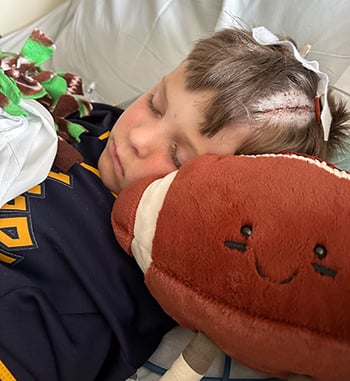 During that first, hour-long surgery, Dr. Arocho-Quinones placed a drain in Blake’s head to relieve the pressure. Over the next couple of days, Blake had to lay still in bed. A nurse would come in with a tape measure to ensure he was staying exactly at a specified level.
“If he’s too low, that could cause overdrainage, which can lead to complications like intracranial hemorrhages,” said Dr. Arocho-Quinones, who is also an Assistant Professor of neurosciences at the Medical College of Wisconsin, the academic partner of Children's Wisconsin. “Too high could lead to underdrainage and the return of the elevated intracranial pressures.”
“That was really tough on Blake,” said Rebecca. “For a kid who always had a ball in his hand, who was constantly active and playing sports, to have to lay perfectly still in bed was really a challenge.”
On Tuesday, Blake underwent additional testing. With the pressure in his skull normalized, he was able to comfortably undergo an MRI of his brain and spine, which revealed a lot more details about the tumor.
On Wednesday afternoon, Rebecca and Eric attended a care conference to review Blake’s case. Dr. Arocho-Quinones was there from Neurosurgery, as well as doctors from Neuropsychology, the MACC Fund Center for Cancer and Blood Disorders and the Genetics and Genomics Program.
“My husband and I walked into the room, and I felt like I was going to throw up,” said Rebecca. “You're walking in not knowing if they're going to tell you that your son has three months to live or what.”
The Best of a Worst Case
Dr. Arocho-Quinones explained that Blake, in fact, did have a large tumor in his brain. Most likely it was a subependymal giant cell astrocytoma (SEGA) — a rare but slow-growing and benign tumor. She believed he was likely born with it, and it had grown slowly over time.
That, if you can believe it, was the good news.
The bad news was they thought the tumor was likely caused by a genetic disease called tuberous sclerosis complex (TSC). TSC is extremely rare, affecting less than 50,000 people in the United States. Triggered by a gene mutation, TSC causes benign tumors to grow throughout the body — in the brain, lungs, kidneys, heart, eyes and skin. There is no cure.
In most cases, TSC is diagnosed in babies when they start to have seizures caused by tumors or tubers in the brain. Most kids with TSC have some degree of physical or cognitive disability. Many need wheelchairs and have trouble speaking. But Blake never had any symptoms. He was a star athlete and excelled in school. In fact, Rebecca said Blake never so much as had a headache in his life.
“We were in shock,” said Rebecca. “But on the spectrum of kids who have TSC, the doctors had never seen a kid so high functioning as Blake.”
The Second Surgery
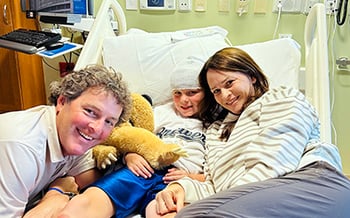 Now with a likely diagnosis, it was time for Blake’s second brain surgery. There was no time to do a biopsy or shrink the tumor with chemotherapy — it had to be removed right away. This second surgery took place on Thursday — still just four days after that first headache crept up.
“The surgery took 11 hours,” said Rebecca. “It was the worst day of my entire life.”
But it was successful. Dr. Arocho-Quinones was able to remove the ping-pong-ball sized tumor from deep in Blake’s brain.
“Because the tumor was located so close to important structures of his brain, specifically those related to his short-term memory, we had to be very careful to remove the tumor but not cause any injury,” said Dr. Arocho-Quinones. “Thankfully, we were able to remove all of it.”
Over those harrowing four days, Blake, his parents and Dr. Arocho-Quinones (who they call Dr. Elsa) formed a quick bond.
“She was very caring,” said Rebecca. “She talked about how she has a son the same age as Blake, very similar personality, and offered what she would do if she were in our shoes. That personal connection meant a lot. She is great, just amazing.”
On Thursday, Jan. 31, just eight days after that call from school, Blake went home.
Back To Being Blake
 A sample of the tumor tested during the second surgery and subsequent genetic testing confirmed the diagnosis of TSC. As a result, Blake will be under the care of multiple Children’s Wisconsin doctors for the rest of his life. While this tumor was caught and removed, there are two others in his brain that have not yet grown. And he may develop others later in life.
“The good news is now we know he has this disease,” said Rebecca. “We'll be constantly monitoring him so hopefully we’ll never have another emergency situation.”
That means Blake comes to Children’s Wisconsin just about every week for appointments. With the help of the Complex Care Program, Blake sees 15 different specialists. He undergoes a brain MRI every six months. He has his kidneys, lungs, heart and eyes checked. He has an EEG every three months to monitor his brain’s electrical activity to check for any seizures. In case he ever does, they now carry rescue medication with them wherever they go.
But he hasn’t let any of that slow him down. Within just a few months, he was back on the baseball diamond — wearing a helmet at all times, at Dr. Arocho-Quinones’ insistence, to protect the still-healing piece of skull that had to be removed during surgery. From there, basketball. And then flag football. Blake is never not moving, always with a ball in his hand.
“Blake is living life to the fullest. If you met him on the street, you would never know what happened to him,” said Rebecca. “We are so grateful. If there's one thing that I learned from all of this is if you think something is wrong, you go to Children’s Wisconsin. Don't be afraid to follow your gut.”
Children's Wisconsin Resources

Written by
Writer
Related Stories
No related articles found.