

One Step at a Time: Helping Baby Oliver Start Life on the Right Foot
At around a year old, Oliver hasn’t quite mastered walking — but he should be able to accomplish whatever he sets his mind to. In just a few short years, he could learn to ride a bike or climb a tree. He might fall in love with basketball or soccer and enjoy hikes along the lake. These possibilities are normal for most families, but for Oliver’s parents, they feel a bit like miracles.
At a routine 20-week anatomy scan, David and Danielle got the unexpected news that Oliver had bilateral club foot, a congenital condition that causes both feet to turn inward and downward. While the condition is relatively common, affecting 1 in 1000 babies, it also requires urgent treatment. When treatment is effective, babies with club foot can go on to live normal, healthy lives. Thanks to the support of their care team at Children’s Wisconsin, David and Danielle are now confident Oliver will, too.
Navigating Uncharted Territory
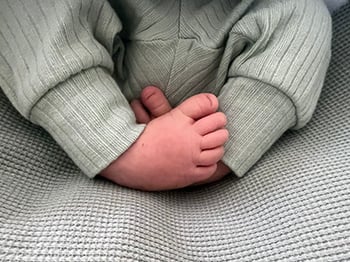 Though both of them are nurses, David and Danielle didn’t know much about club foot. “This was my first pregnancy, so we were pretty scared and didn't know how it would affect him,” said Danielle. Finding the best possible treatment was a top priority, but living in the Upper Peninsula of Michigan meant limited options for pediatric specialists. Hoping to find recommendations elsewhere in Michigan or Wisconsin, Danielle joined a Facebook group for parents of children with club foot.
In the Facebook group, Danielle read glowing reviews about Benjamin Escott, MD, a Pediatric Orthopedic Physician at the Children’s Wisconsin Milwaukee Hospital. She called Children’s Wisconsin and learned about another experienced physician who practiced in Appleton, a full 90 minutes closer to home.
David and Danielle met with Lindsey Kent, DO, a Pediatric Orthopedic Physician who sees patients in the Children’s Wisconsin Appleton Clinic, a few weeks later to discuss a potential treatment plan. Their anxieties were immediately put at ease by Dr. Kent’s experience and approach. “We had so many questions, and she was not only knowledgeable, but so calm and reassuring,” said David. “She laid out all the possibilities with compassion.”
For example, Danielle and David love spending time outdoors, skiing, biking and running — so naturally, they worried Oliver wouldn’t be able to do those things. “We learned that professional athletes, like Mia Hamm and Leroy Butler, who invented the Lambeau Leap, also had club foot,” said Danielle. “Dr. Kent was confident he could play whatever sport he wanted, which really helped calm our fears.”
A Successful Treatment Plan
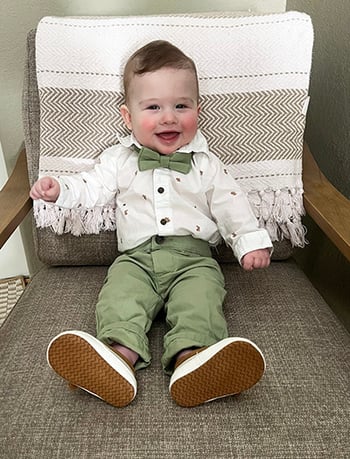 Dr. Kent ultimately recommended the Ponseti treatment method, which involves a series of casts that would hold Oliver’s feet in the correct position. Dr. Kent’s training and experience with the method gave David and Danielle much-needed reassurance during a time of so many changes.
Oliver was born on July 30, 2025, and he saw Dr. Kent for his first cast just two weeks later. The treatment plan was intense: For his first eight weeks of life, Oliver wore a hard cast that went from his toes to the edge of his diaper. Every week for five weeks, the family traveled three-and-a-half hours to and from the Appleton Clinic for new casts.
Recognizing the stress navigating medical treatment for a newborn, the Children’s Wisconsin care team set a calming tone from the beginning. “We felt like the whole care team really knew Oliver and us, and that we knew what to expect,” said Danielle. The clinic went the extra mile for Oliver and his family, keeping afternoon appointments open to accommodate their drive time and ensuring they saw the same medical assistants each visit. They even helped coordinate visits with Oliver’s other Children’s Wisconsin doctors in Appleton to save the family time.
At appointments, the family’s comfort was Dr. Kent’s priority. “Babies pick up on how their parents are feeling, so I think it’s so important to create a calming environment for the whole family,” said Dr. Kent. She played calming Beatles lullabies while she removed and put on Oliver’s casts, and after one visit, she sent the family home with a toy for the long car ride.
It’s common for families of babies with medical needs to miss out on milestones, and Dr. Kent did her best to create moments for the family to bond. Babies with club foot can’t have regular baths with casts on, so the clinic set up a small bath for Danielle and David to give Oliver his first one. “I get to see families more than their pediatrician, so I’m there for so many important milestones, medical and otherwise,” said Dr. Kent. “It’s so special to watch families soak that in during an otherwise challenging time.”
A Bright Future
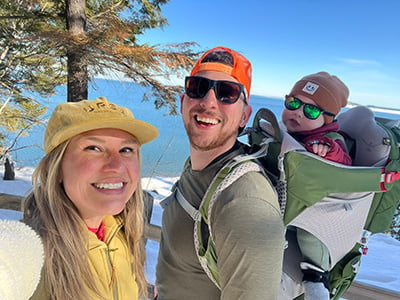 After two months of casting, Oliver had a routine surgical procedure at the Children’s Wisconsin Milwaukee Hospital to loosen his Achille’s tendon. He’s since graduated to the last stage of Ponseti treatment, which involves wearing braces with shoes attached to a bar for most of the day to keep his feet from turning back. He’ll keep up this regimen for a few more months, after which point he’ll only wear the boots at night, then not at all. Dr. Kent will see Oliver every few months until August of 2026, and then once a year after that.
Oliver’s treatment has proven successful: Oliver now has full range of motion and loves to play with his feet, just like any other baby. Looking back, David and Danielle are surprised how much joy filled a potentially stressful journey.
“We saw our child go through something so hard,” said Danielle, “and thanks to our interactions with the team at Children’s Wisconsin, we were somehow still able to smile through it.”
Children's Wisconsin Resources

Written by
Writer
Related Stories
No related articles found.