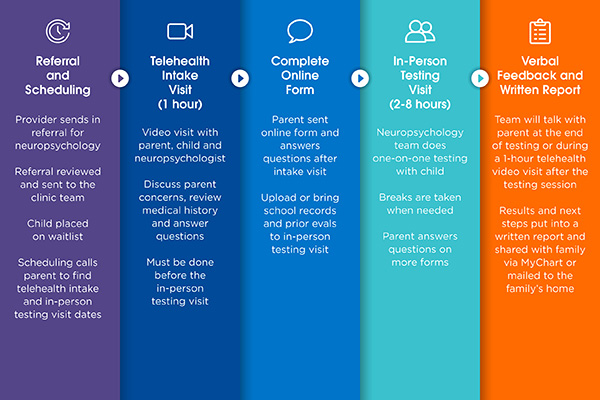
Your pediatric neuropsychological evaluation is tailored to meet the needs of your child. Neuropsychology evaluations take between two to six hours to complete. Depending on the age and needs of your child, testing may be completed in one day or over the course of several days.
You will be asked to participate in an interview (through video visit) regarding your child's developmental history and to complete several questionnaires about your child's emotional and behavioral functioning. Your child will need to be present throughout the interview.
One to two testing sessions may be scheduled. Your child will be asked to complete a variety of paper and pencil, puzzle, and computer tasks similar to things your child may do at school. For very young children and infants, the test session looks more like play. The testing will be conducted by highly trained psychometrists who work with your child in an individualized setting.
Results of testing and recommendations from the evaluation will be shared with you either at the end of the testing day or during a virtual visit scheduled for a separate day. You will also receive a written report of all results.
Neuropsychological Evaluation
Prerequisites for Evaluation
- Patient must have a medical, neurological, and/or genetic disorder impacting brain or central nervous system (rare exceptions)
Presenting Concerns/Diagnoses Served
- Cognitive dysfunction
- Cognitive delays
- Changes in cognition
- Pre/Post neurosurgery
- Impact of medical treatment on cognitive functioning
Evaluation Goals
- Differential diagnosis of neurobehavioral syndrome/cognitive dysfunction
- Identification of cognitive strengths and weaknesses
- Identification of interventions needs
- School recommendations
- Determine neurosurgical and/or treatment risk
Typical Assessment Tools
- IQ/General cognitive functioning
- Attention
- Executive functioning
- Processing speed
- Fine motor dexterity
- Language
- Visual-spatial/nonverbal
- Social/Emotional functioning
Typical Recommendations
- Integration of cognitive profile for medical treatment/surgical planning
- Need for services (e.g., OT, ST, medication, etc.)
- School strategies and programming
- Therapy approaches and referrals
Who Is a Pediatric Neuropsychologist?
A pediatric neuropsychologist has earned a PhD or PsyD in clinical psychology and has completed specialized training including a post-doctoral fellowship in neuropsychology.
A pediatric neuropsychologist specializes in examining how learning and behavior are related to the development of children’s brain structures and systems. A pediatric neuropsychologist specializes in examining how brain injury or disease can impact a child’s brain development and their learning and behavior.
A few common techniques used by neuropsychologists include both computer- and paper-based tasks. After testing, our neuropsychologists interpret the results and provide research-based recommendations to help your child progress and learn at their fullest potential.
Evaluations vary depending on the age and development of the child and why they were referred for an evaluation. Some reasons for referral include:
- Determine the child's level of cognitive functioning
- Identify changes in brain function as a result of medical/neurological illness or injury
- Assist in school and medical treatment planning
- Determine level of functioning prior to treatment/intervention (baseline testing)
- Determine response to or recovery from treatment/intervention (follow-up testing)
- Monitor brain development and guide treatment decisions
Pediatric neuropsychological evaluations look at various different aspects of brain health and development. Some areas include:
- General intellectual abilities
- Attention capacity
- Executive skills (organization, planning, inhibition or flexibility)
- Learning and memory
- Language skills
- Visual-spatial skills
- Fine motor coordination
- Behavioral and emotional functioning
- Social and academic skills