
Breastfeeding: Your Baby’s Nutrition
How Can You Make Sure That Your Baby Gets the Best Nutrition Possible?
Children’s Wisconsin and the American Academy of Pediatrics (AAP) recommend babies are breastfed or given breastmilk exclusively for the first 6 months of life. Breast milk is the best type of nutrition for babies and helps protect them from getting sick.
What Options Do You Have for Your Baby’s Nutrition?
- Directly breastfeeding
- Pumping milk and feeding from a bottle
- Feeding infant formula
There are many factors that go into deciding how to feed your baby. We are here to support you every step of the way. Whether you’re having trouble producing milk or just looking for some tips, your provider is there to help determine what is best for you and your baby.

Begin To Breastfeed: Getting Started
Breastfeeding is a new skill you and your baby are both learning. Sometimes it can be hard for moms and babies to get it right at first. You may need time, patience, and help.
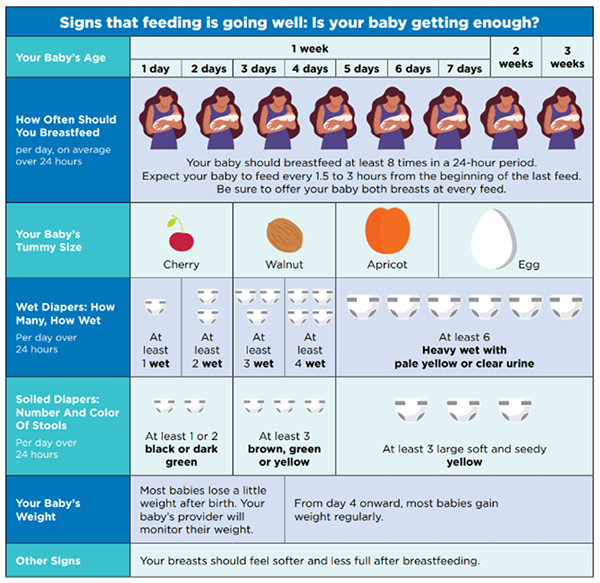
During the first few weeks of breastfeeding, your baby needs to breastfeed often. Frequent feeding will help your baby gain weight and increase your milk supply. Your baby should breastfeed at least 8 times in a 24-hour period. Expect your baby to feed every 1.5 to 3 hours from the beginning of the last feed. Be sure to offer your baby both breasts every feed.
Look for Signs Your Baby Is Ready To Breastfeed
When your baby shows cues, even after an hour, feed your baby!
Feeding cues include:
- Making sucking noises or smacking lips
- Trying to suck on their fists.
- Searching for your nipple or “rooting”.
There Are Many Ways To Position Your Baby While Breastfeeding
Follow these steps to position your baby on their side:
- Position your baby on their side, turned toward your tummy.
- Hold them close to you. Keep their ear, shoulder and hip in a straight line.
- Support your baby’s neck and shoulders. Place your hand at the nape of the neck. Do not hold or push on your baby’s head.
- Bring your baby to your breast, not your breast to them.
- Support and lift your breast with your other hand.
- Make sure that your fingers are away from the areola. This is the dark area around the nipple.
- Align your baby’s nose to your nipple.
After Getting Your Baby in Position, Follow These Steps To Get a Good Latch
- Touch or stroke your baby’s top lip with your nipple. This will make your baby open their mouth.
- Make sure your baby opens wide enough to take in both the nipple and about 1/2 to 1 inch of the areola.
- Do not push your nipple in. Be patient and wait for your baby’s mouth to be wide open.
- When your baby’s mouth is wide open, bring them toward you quickly.
- Make sure the baby’s tongue is underneath the nipple.
- The upper and lower lips should be curled out like “fish lips,” not pulled in. The initial latch may feel slightly tender, but then suckling is comfortable.
- With suckling, watch and listen for a swallow. Your baby’s suck should be strong and steady. Your baby should be swallowing often.
- If the latch is persistently painful, you may need help. Reach out to your baby’s primary care provider’s office.
Signs That Your Baby Is Getting Enough Breastmilk
- When your baby is full, your baby will let go of the breast and seem satisfied.
- Your baby will not display feeding cues (rooting, sucking on fingers) after a feed.
- Some babies fall asleep but don’t let go. If your baby hasn’t suckled in a minute, they may be sleeping.
- To remove your baby from your breast, slide your finger between your nipple and their tongue to break the seal before pulling out your nipple.
- Always feed your baby when they are showing signs of hunger, even if they just ate an hour ago.
- At the next feeding, change the breast you start with. A baby’s suck is always stronger at the beginning of the feeding.
Breastfeeding is a journey that can be filled with challenges and rewards. Children’s Wisconsin is here to support you and your baby in meeting your feeding goals.
Children’s Wisconsin offers a variety of services to mothers with questions about breastfeeding, pumping and more. Certified lactation counselors are available to help and support families. Call your baby’s primary care provider for more info or to ask for breastfeeding support from our Lactation team.
To learn more about breastfeeding, visit Children’s Wisconsin.

Draft Number: 2175Revision Date: February 1, 2026