

A Whole New Boy: How Kole Found Hope for a New Life After Years of Illness
A 2-month-old with a failing liver — this should be the low point, a rock-bottom of hope. But for Kole Duernberger, it was somewhere near the beginning of a rollercoaster of impossible medical situations.
“I think he has a complication with every organ except for his lungs,” said Ashley, Kole’s mom.
During his 20-week ultrasound they “couldn’t find one of the kidneys,” and there were “a few things with the heart — a small hole, an extra vein, the aortic valve was very narrow.”
Kole was born on Oct. 12, 2022. From there began a series of one health battle after another. There’s been so many that while running through Kole’s history, Ashley nearly forgot the time there was a blood clot in one of his veins. He had to receive shots twice a day in the leg for three months.
“I had to hold a 2-year-old down and poke him in the leg. He would be screaming. ‘Please, Mama, no!’” She summed it up as “another process.” The seemingly endless number of issues makes it hard to tell where one ends and where the next one begins, what causes which symptom. Everything in their life was a blur of drugs and doctors.
When Kole was 2 months old, he had a follow-up ECHO exam with his cardiologist. While he was happy with the progress of Kole’s heart, he did note a worrying shade of yellow to his skin. He sent Kole for immediate lab work.
“He called me a couple hours later and let me know Kole’s liver was not functioning and that we needed to go to Children’s Wisconsin, now,” Ashley said of the most unsettling of conversations.
A Worst-Case Scenario
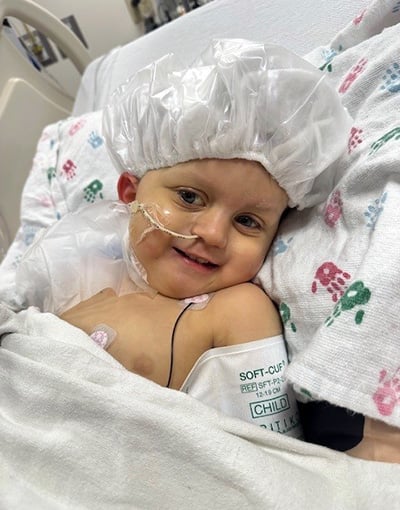 At Children’s Wisconsin, a troubling diagnosis was first introduced: biliary atresia. In this serious, rare and little understood condition the bile ducts are blocked, which can lead to severe liver damage.
“It’s kind of the worst-case scenario for a baby that comes to you that is jaundiced,” said Alexis Gumm, MD, a Pediatric Gastroenterologist and Transplant Hepatologist at Children’s Wisconsin. “We see about three cases a year here at Children’s Wisconsin, and it’s the most common indication for liver transplant in pediatrics. It’s the big scary thing we don’t want to miss.”
The standard course of treatment is a complicated surgery called the Kasai procedure, which involves removing the damaged bile ducts and using part of the small intestine to create a new path for bile to flow out of the liver. If biliary atresia is caught within the first 60 days of life, the Kasai treatment is much more effective. But still, according to Dr. Gumm, about one-third will need to be transplanted before 1 year of age, one-third before 18 and one-third will make it until adulthood, but will likely still need a transplant at some point. “It just kind of delays a liver transplant.”
Ashley describes the ordeal of the eight-hour procedure, involving a huge incision, a frightening prospect for anyone, let alone someone exactly 60 days old.
“It was in hopes it was going to save his liver. During the surgery they discovered there was no gall bladder, he had a malrotation, and one of his main veins was in front of his liver instead of behind it. They were lucky they didn’t cut into it. It was a really long procedure. It was really scary.”
And yet it wasn’t long before Kole was home, attending daycare, on his way to a new type of normalcy. There were many follow-ups at Children’s Wisconsin, and there were struggles with keeping food down, with gaining weight, with a willingness to use his legs — remedied by months of in-home physical therapy. Still the future looked bright, with possibility, for the kid Ashley describes as the “most talkative, mobile child you’ve ever met.”
Everything Was Different
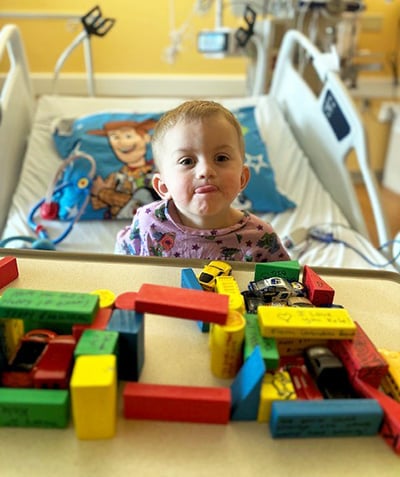 But in November of 2024, Kole got sick. And this time, everything was different. A virus seemed to kick off an avalanche of struggles and multiple weeklong hospital stays before the holidays. The family somehow got through Christmas at home, but Kole was unable to stay healthy, to shake the fevers and germs of viral season.
“This is what happens when the liver is giving up,” said Dr. Gumm.
One day in early January 2025, daycare called Ashley, telling her they couldn’t get Kole to stay awake. First was a bout of hand, foot, and mouth disease. Then came the buildup of fluid in his belly that needed to be regularly drained with a needle. This required sedation, and at one point he had to remain intubated for almost a week. His liver had begun to shut down and he had developed new blood vessels around his sick liver to his esophagus and stomach, causing Kole to have bloody diapers and vomit blood. Transfusions were continuous, eating was nearly impossible, doctors inserted bands on his esophagus and coils in his stomach to help stop the bleeding.
These were tough circumstances to frame Ashley’s first meeting with Dr. Gumm. It also marked the lowest, most emotional point in the family’s years-long ordeal.
“We were told, ‘It’s transplant time. We need to do whatever we can to get him a new liver.’”
But even getting on the transplant list presented its own challenges. An ill patient cannot be active on the transplant list, and Kole had been diagnosed with an infection called Spontaneous Bacterial Peritonitis (SBP). SBP is a dangerous infection of the fluid in the abdomen, common in advanced liver disease, that can be difficult to treat. Kole started an antibiotic IV treatment, a remedy that could take up to a month for results. Eventually a drain was inserted, with liters of fluid flowing out of Kole’s stomach. Although it felt like doctors were doing everything possible, Ashley felt despondent.
“The transplant list process is probably the most frustrating thing I’ve ever been through,” she said.
In a month, the infection cleared, and Kole went active on the donor list, only to come down with rhinovirus four days later. It took another two weeks for him to be healthy enough to be relisted, and the waiting began in earnest. Again. Due to continued concerns with bleeding, the family had settled in for an extended stay at the hospital.
“It felt like it never was going to come,” Ashley said. “It wasn’t that long but it felt like it was.”
Hope for a New Life
On Feb. 20, 2025, the call came.
On Feb. 22 at 11:30 p.m., Kole entered surgery — and with it came hope for a completely new life.
The eight-hour procedure gave Kole’s mom and dad time for anxieties most parents can’t begin to imagine.
"There are so many things that could go wrong,” Ashley said. “I knew that they knew what they were doing. But the liver has to work, the body has to accept it.”
Raj Prasad, MD, Medical Director of Liver Transplant Children's Wisconsin, is a foremost expert. While two to four liver transplants are performed at Children’s Wisconsin per year, Dr. Prasad oversees 65-70 in all age groups at Froedtert Hospital in his role as Surgical Director of the Liver Transplant Program and Professor of surgery at the Medical College of Wisconsin, the academic partner of Children’s Wisconsin. But at Children’s Wisconsin he feels the intensity at a different level.
“Every child I operate on is like the first one. It never gets any easier,” said Dr. Prasad. “It’s very personal. I always remember the privilege of operating on these children because of the trust the family places on me. I never take it for granted. I feel every time I have to earn that.”
Kole was out of surgery at 8 a.m. the following day, the only complication being thrombosis in the portal vein. It sounds concerning, but Dr. Prasad described it like someone dealing with a mild annoyance on another day at the office: “It complicates it a bit.”
Otherwise, the surgery went smoothly. On March 6, just two weeks after transplant, Kole was sent home. So far, he seems to be progressing ahead of schedule, having already been weaned off steroids, and multiple of the dozens of medications.
A Whole New Person
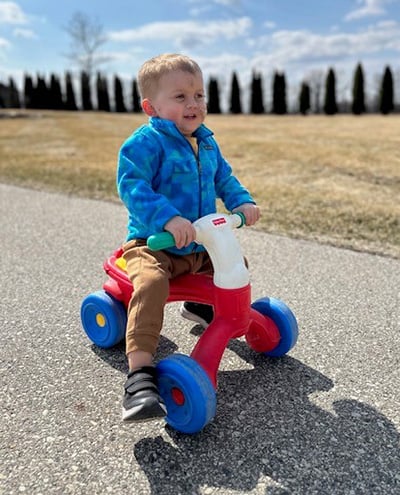 With a surgeon’s steadiness Dr. Prasad outlines Kole’s prognosis with grounded hope. “There’s always the initial rate of close monitoring, but especially once he passes a year, if the new liver is healthy, working and he’s growing — they do need to carry on with medication — they have a fairly normal life,” said Dr. Prasad. “Not just could, they will have a normal childhood in that way, going to school, playing, contributing and participating in everything life has to offer.”
Ashley feels like Kole is already a whole new person.
“I don’t know what we would do without Children’s Wisconsin,” she said. “We were there from Jan. 10 until March 6. It was a wonderful experience. Everyone there was great. We walk in and people remember Kole. We go to the Delafield and Wauwatosa Clinics, and they know who we are. It feels like family when we go. It always feels right. I can’t imagine going anywhere else.”
Right now, everything is on a brief pause as Kole finishes up Rituximab infusions to treat a B-cell buildup in the adenoids and bowels — a common side effect after a transplant. He’s taking a break from daycare. And while he looks like a normal kid and does everything all his 3-year-old friends do, his immune system is compromised. He still sees his physical therapist and has regularly scheduled ultrasounds.
“It’s very average now,” Ashley said with gratitude. “Not normal, but pretty normal. He loves going everywhere, to school, loves his friends and teachers, playing cars and trucks and excavators — boy things.”
These are all the things Kole can look forward to, everything that is on the horizon. But the trials of the first three years of his life will never be that far away. Nor will the people that have gotten the family to the place of peace where it sits today. For Ashley, she still fixates on a frightening moment a day or two after the transplant. The liver enzymes were going up, and Dr. Prasad popped in to look at the ultrasound pictures as they were happening — just checking in, making sure everything was alright.
“He cared enough to come look at the pictures on the spot,” she said. “It really mattered to him, which made me feel like he cared about Kole as much as I did.”
Children's Wisconsin Resources
Written by
Writer
Children's Wisconsin specialty care providers have advanced training and expertise in many areas of pediatric medical care, including allergies, dental, dermatology, emergency medicine, ENT, gastroenterology, neonatology, surgery and more.
Related Stories
No related articles found.